|
|
| |
|
|
| |
|
Charles Deemer MFA, Playwriting, University of Oregon Writing faculty,
Portland State University (part-time) Retired playwright and screenwriter.
Active novelist, librettist and teacher.
cdeemer@yahoo.com.

Links:
Literary archive
Personal home page
Photo
Electronic screenwriting tutorial
Online writing classes
References
Bookstore
Highlights:
Dress Rehearsals
A memoir


Love At Ground Zero

Seven Plays

Oregon Book Award finalist
Blogs by (mostly) creative writers:
"Can We Talk About Me For A Change?"
Playwright Debra Neff Nathans
Inkygirl
Debbie Ridpath Ohi, a weblog for writers (resources)
Silliman's Blog
Ron Silliman, contemporary poetry and poetics
Maud Newton
literary links, amusements, politics, rants
Darren Barefoot
Technical and creative writing, theatre, Dublin
Rob's Writing Pains
Journey of a struggling writer.
Mad, Mad World
Cara Swann, fiction writer, journalist, "reflections on humanity, random news & my life."
Writeright
Random musings on a writer's life and times.
Flaskaland
Barbara Flaska's compilation of the best online articles about music and culture.
Write Of Way
Samantha Blackmon's written musings on writing (composition and rhetoric).
Alexander b. Craghead: blog
Writing, photography, and watercolors.
Rodney's Painted Pen
Rodney Bohen's daily commentary "on the wondrous two legged beast we fondly refer to as mankind."
His pen runneth over.
Frustrated Writer
This one named Nicole.
scribble, scribble, scribble
Journalist Dale Keiger teaches nonfiction scribbling to undergraduate and graduate students at Johns Hopkins University.
The Unofficial Dave Barry Blog
The very one.
The Hive
The official blog of science fiction / horror author Terence West.
William Gibson Blog
Famed author of Neuromancer and Johnny Mnemonic: The Screenplay.
The Word Foundry
Joe Clifford Faust's "blog of a working writer: tracking writing projects, musings on the
creative process, occasional side trips into music, media, politics, religion, etc."
A Writer's Diary
By Cynthia Harrison, who has the good sense to quote Virginia Woolf: "The truth is that writing
is the profound pleasure and being read the superficial."
Bow. James Bow.
The journal of James Bow and his writing.
Ravenlike
Michael Montoure's weblog about writing, primarily horror and speculative fiction.
Globemix
By David Henry, "a poet's weblog from Aberdeen, Scotland."
Modem Noise
By Adrian Bedford, a "fledgling Pro SF Writer, living in Perth, Australia."
boynton
"A wry writerly blog named in honour of a minor character in a minor Shirley Temple film."
Real Writers Bounce
Holly Lisle's blog, "a novelist's roadmap through the art and ordeal of finding the damned words."
2020 Hindsight
By Susan.
downWrite creative
Phil Houtz's notes on the writing life.
Vivid: pieces from a writer's notebook
Blog of Canadian poet Erin Noteboom.
The Literary Saloon
The literary weblog at the complete review.
Rabbit Blog
The rabbit writes on popular culture.
This Girl's Calendar
Momoka writes short stories.
Twists & Turns
Musings by writer Michael Gates.
Plays and Musicals -- A Writer's Introspective
A blog by John D. Nugent - Composer, Playwright, and Artistic Director of the Johnson City Independent Theatre Company
The American Sentimentalist
"Never has any people endured its own tragedy with so little sense of the tragic." Essays by Mark W. Anderson.
Screenwriting By Blog
David C. Daniel writes a screenplay online. "I've decided to publish the process as a way to push myself through it.
From concept to completion, it'll be here."
SeanAlonzo.com
Official site of occult fiction author Sean-Alonzo, exploring symbolism, alternative
history, philosophy, secret
societies and other areas of the esoteric tradition.
Crafty Screenwriting
Maunderings of Alex Epstein, tv scribe, about life, politics, and the tv show I'm co-creating.
Letters From The Home Front
The life of a writer, 21, home schooled, rural living.
Venal Scene
The blog of bite-sized plays inspired by the news (by Dan Trujillo).
'Plaint of the Playwright
Rob Matsushita, a playwright from Wisconsin, "whines a lot."
I Pity Da Fool!
Glenn's adventures in screenwriting.
Time In Tel-Aviv
Hebrew modern literature at its best, by Corinna Hasofferett.
Big Window
Robin Reagler's poetry blog.
John Baker's Blog
Author of the Sam Turner and Stone Lewis novels.
Suggest a writer's blog
|
|
|
|
The Writing Life...
"And it came to pass that all the stars in the firmament had ceased to shine. But how was anyone to know?"
The Half-Life Conspiracy
|
|
| |
Friday, January 31, 2003
Death with dignity
Visited my cancerous poet friend today and was shocked to see how much worse he is since I visited on Wednesday. He says he's not in pain etc but he's aged 30 years in 2 days and looks very much like what he is, dying. They are zapping his brain, hoping to reduce swelling there so he might regain some of his lost speech.
I'm not sure I'd put up with treatment. Quality matters more to me than quantity. I probably need to get ready for my own surprise, maybe by joining the Hemlock Society.
1/31/2003 07:13:56 PM |
"Local writer"
I've never liked being called "a local writer." No harm is usually meant by this, at least not consciously, but the subtext is always this: nobody ever heard of you beyond this locality. No one in New York calls Norman Mailer "a local writer." No one here in Portland calls Ursula Le Guin "a local writer."
I'm not called much of anything by anyone these days but in the 1980s, the decade in which I had the most press coverage, I frequently was called "a local playwright." Later, as the press in Seattle began to pay attention to me, I graduated to being called "a regional playwright" or "a Northwest playwright." But to be a playwright, a real playwright, in this country, you have to get produced in New York city. Although I've twice had plays scheduled to be produced there, once very early in my career and again less than a decade ago, neither play actually hit the boards (in the first case, the company decided to declare bankruptcy; in the second, I pulled the play after an irresolvable difference with the director -- and thank the gods I could do this, which is not something that a screenwriter can do). Since the birth of the Internet, I've been produced in Ireland, Chile, Spain, Turkey, Sweden, England ... but not in New York. I'm not "really" a playwright. End of story.
Today most of my readers find me on the Internet, not in libraries. My literary archive, hosted by the University of North Carolina and accessible online, continues to get good traffic (over 200 hits a day on the average, with peaks much greater than this, such as 700+ hits yesterday), though it's hard to know how many are just browsing and how many download or read something. But most of my recent play productions have come directly as a result of having my work accessible on the Internet.
In the 1980s, when I was playwright-in-residence at several theater companies here in Portland, where I developed and premiered my new work as a matter of course, it made sense to call me "a Portland playwright," though this was never what I called myself ("just a playwright, ma'am"), but it certainly doesn't today when I'm seldom produced here. Yet now and again I see myself called "a local playwright" or "local author" in some passing mention or other, often nostalgic (as in, "whatever happened to ..."). My best plays -- both in my judgement and in the number of awards they've won -- have never had "a local" production, but locally my career as a playwright appears to have ended in the 1990s when I stopped premiering my work here. That's how provincial Portland can be.
Even though I abandoned the short story for decades, my national reputation was strongest in the 1970s when three of my stories were considered for publication in the annual anthology Best American Short Stories, finally being selected to the "Roll of Honor," the anthology's "almost" award (the stories are The Sextant, Presenting the Annual Interracial Pig Roast, and The Idaho Jacket). During this decade I was regularly publishing stories in some of the major literary magazines. No one called me "a local writer" in Eugene, where I lived during most of that period.
I've always considered my home the library. This is where I like my work to end up. If your work is in the library, anything can happen at any time. A pretty obscure essay of mine that was published in College English in 1967 inspired a recent book 35 years later (details here). Something like that makes a writer, at least this writer, feel good. I read things that inspire me; it's great to write something that inspires someone else.
One of the nicest gifts I've ever received was from my second wife, to whom I was married when I received my MFA in playwriting. My thesis was a play, which was produced by the University of Oregon, and the library put the script in its collection. The gift was a T-shirt -- with the Library of Congress number of my play on it. The woman knew what matters to a writer.
1/31/2003 05:12:58 AM |
Thursday, January 30, 2003
Women I have tried to know
Some projects come together quickly, especially shorter ones. A short story's journey from concept to final form can take place in less than a week. If a screenplay takes longer than three months, start to finish, then usually something is fundamentally wrong in its concept. Novels, I am learning, can take forever. A stage play generally took me less than six months, start to finish.
But sometimes an idea rattles around in the brain for a long time, begging for release but finding no form for its embodiment. I've had such a story in my brain for twenty years now, with the working title Women I Have Tried To Know. This was originally conceived of as a stage play for two players: an actor-protagonist and an actress portraying the six or eight women who pass through his life. With its high theatricality, the female role would be one many actresses would die for, always a plus in marketing. Unfortunately, my several false starts never got anywhere because I never could find the spine to this story, what saved it from being an episodic dark comedy, what it all added up to. So the idea still bugs me.
What I do know is that the idea has autobiographical roots. Surely nothing is messier in my past than my relationships with women. The women who pass through the guy's life above no doubt would be "inspired by" women who have passed through my life. To scratch the iceberg, consider these three wives and three live-in girlfriends:
J. was a sweet girl I knew in high school. For a while, a good buddy was dating her and I thought maybe I'd end up best man at her wedding, not the groom. Then he committed suicide.
I ran into J. again when I was in the Army studying Russian at the language school in Monterey. J. was going to college at San Jose State. We started dating, one thing led to another, and we became engaged. Then we got crazy.
At a sorority party, her best girlfriend decided to run off to Reno to marry, and we volunteered to stand up for them. We all poured ourselves into a car and headed out at something like two in the morning. To make a long story short, by the time we got there it had become a double wedding. Shortly thereafter I shipped off to Germany, and we tried to annul the marriage but the Army had rules against that sort of thing, no doubt protecting G.I.'s from getting divorces to marry bar maids. So we stayed married during my three-year hitch.
The next mistake was deciding to make a go of it after I got out of the Army. Some people never learn. By the time I entered graduate school, the marriage was on the rocks and we divorced shortly thereafter.
After this, in graduate school, I met the leading candidate for the love of my life. She was also a grad student, very bright, very beautiful, and very independent. She used to brag that she'd never met a man who could drink her under the table -- until a mutual friend fixed us up, and she found her match. Naturally we fell in love with one another.
Our grad school years together remain the happiest time of my drinking days. We both were very functional drunks, still early in that progressive nightmare, and we were rolling in dough, a very unusual situation for grad students. I had a teaching assistantship, a playwriting fellowship, and the G.I. Bill, plus income as a part-time journalist and part-time folksinger. P. had a full fellowship. We lived like royalty on half our income, saving the rest for summer travel, and still managed to keep most of the graduate English students in beer and barbecue. I remember thinking I was in heaven, this surely was what the writing life was all about.
Before disaster struck from booze, an unexpected crisis appeared when P. decided she was, in truth, a lesbian. I am sorry to say that I didn't react to the news with grace or good manners. This helps explain why she won't talk to me to this day, even though, in my view, I wasn't the one who terminated the relationship.
What I did, among a family of dumb stunts, was have an affair with a student of hers. J. became a live-in girlfriend, moving across the country to join me in Oregon after she graduated. Total disaster. The good news is it lasted only a few months.
The next live-in girlfriend is the other candidate for soul mate, and surely the most unusual relationship with a woman I've had. I knew L. since she was about eight; she was the daughter of a buddy of mine. Back in Oregon after the divorce from P., with the quick tornado of J. come and gone, I was free, as they say, and flew down to San Francisco to spend Thanksgiving with old friends. The host had a hot tub, and one afternoon I was in it alone, having arrived early and waiting for him to get home from work, when who should walk up, disrobe, and get in but his daughter, L., whom I hadn't seen since she was a teenager, about ten years earlier. Something of a homely kid, she'd turned into a gorgeous young woman. She also was a very talented singer and musician.
Another long story short, we scandalized the holiday by spending all our time together, flirting big time. I used to baby sit her! When I returned to Oregon, we corresponded, she visited, then again, and she ended up moving north to move in with me.
This, too, was a great time -- for a while. It was best when I was writing plays with songs in them and letting L. write the songs. She had an incredible talent to write the perfect song for the perfect moment. What eventually came between us, though, was not the considerable age difference but a difference in life styles, summarized by our different drugs of choice. I was a wild man drunk, and she was a laid back pothead. Our energy levels happened on different tracks.
The good news is that we remain very tight friends. She's back in S.F. and just turned ... my God! ... fifty. She's alone, a bit lonely (which I don't understand, given her talent and beauty), but hanging in, and we exchange email several times a week. She's a dear, dear friend. I feel like she's the little sister I never had, the sister I slept with.
Where are we? I'm losing count. Ah, live-in number three. It's as if I was so tired of pothead mellowness that I found the greatest package of energy I could find. P. was a cokehead and a small time dealer and a big time party animal. We lived together for two or three days before I bailed out, tired of all the late night drug deals. But we stayed together for a few years, until she got busted and did time, and I visited her in prison in Arizona. She was great fun to party with but I had met my match and always pooped out before she did, not having learned the chemistry of mixing drugs for constant refueling. I'm glad to say P. is out of jail and straight these days, though I don't see her very often.
Wife number three was an actress who had been in several of my plays and who decided her mission in life was to save me from myself. Ha ha ha! Well, she sold me the package, but it only took her a few months to learn what an idiot she was, and I returned from a bar one afternoon to find my belongings packed and on the front porch.
Now, from this material, how do you shape a story that is cohesive and moves somewhere? That's what I've been struggling with for twenty years.
I should end by saying I am happily married to number four, whom I met after I'd quit drinking, who has no direct experience of this somewhat sordid past I always seem to be writing about. More and more, that person seems like a stranger to me, too, some buffoon I impersonated in a previous life. He can crack me up and piss me off, all at the same time.
1/30/2003 09:40:54 AM |
Friends, acquaintances, colleagues
I've had several very intense close friendships in my life -- but I appear to be outliving them all. I'm left with acquaintances and colleagues, which are not quite the same thing.
I met my "soul brother," Dick, in 1960 when we both were Russian linguists in the Army Security Agency, stationed in Germany. We hit it off immediately. Dick, a few years older than I, was a "lifer" when I met him, a character who loved the Army, much like Pruitt in From Here to Eternity, but also one of the best read people I'd ever met, who also was trying to become a writer. Dick's problem, however, was that he didn't do much writing; instead he told his stories in the billets and in the bars, wherever he could gather an audience. He was a gifted storyteller.
Dick became a mentor as well as a friend. He introduced me to many things that became important to me: to Woody Guthrie (later I would write and perform a tribute to the folk artist, called Ramblin'); to "God's country," the Pacific Northwest, which this rootless L.A. boy would end up calling home (a transition that is the focus of my short story, The Idaho Jacket, a Roll of Honor selection in Best American Short Stories).
Dick and I quit drinking the same year but Dick didn't take well to sobriety. He was miserable, in fact. He stopped doing anything associated with drinking, which was just about everything. He was a great jazz buff -- and he stopped listening to music entirely. He became a workaholic, self-employed in the mortgage business, and didn't do much beyond working and sleeping and bitching about the state of the world. A born storyteller, an extrovert and social animal, sober he became a bitter and reclusive old man. He died a few years after sobriety of cancer but I can't help but think his attitude accelerated his disease. Dick probably would have been happier if he'd just drank himself to death.
Dick had two sons, and I'm very close to both. One lives in Moscow, Idaho, and runs the family mortgage business. The other is a lost soul, a rock guitar player and drug addict. His mother, an incredible woman, is in her mid-eighties and still alive, in a rest home in Orofino, Idaho, Dick's home town, and the rest home is located on the same property that used to be the Lumberman's Bar, where his mother worked and which was located next to several of Orofino's legal whore houses. I've met guys here in Portland who in high school in the 1950s used to make the drive to Orofino to visit the legal whore houses. Orofino is a dead logging town today but its history is colorful, and hints of it remain if you know where to look. The high school football team is called the Maniacs, which suggests something of the flavor of the place.
I still miss Dick a lot. And soon I'll be missing my poet friend as well -- but in the meantime, I can enjoy him while we can still share our lives.
1/30/2003 03:45:48 AM |
Wednesday, January 29, 2003
Writers and Death
I have a close friend, a poet, with whom I have coffee or breakfast about once a week. He's my closest friend in town, my closest since my "soul brother" passed away in 1998 from cancer. A week ago we had coffee, and my friend complained that he felt like he was coming down with something, maybe the flu. He talked about maybe going to the V.A. hospital for a checkup.
This morning I visited him in the V.A. hospital -- and he's diagnosed with terminal lung cancer, which has spread to his brain.
The thing about entering your sixties is that friends and acquaintances begin dropping like flies all around you. And you can't help but wonder if you're next.
My soul brother, the poet and I are all of the same generation. We all led pretty unhealthy reckless lives early on, working hard and partying hard.
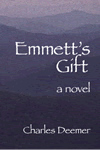
Serious writers deal with serious themes, and no theme is more serious than death. When in a career an individual writer tackles this theme probably depends on personal circumstances, how soon a personal life has to deal with it. My parents died much too early, so I've looked at this theme in my work relatively early, in a cycle of one-act plays called The Death Cycle and philosophically in Christmas at the Juniper Tavern, in short stories like The Sentence and Death is a Paper Tiger, in essays like The Weight of My Father's Soul and most ambitiously in a recent novel, Emmett's Gift.
My poet friend has studied eastern religion and is very comfortable with his fate, moreso than his family and friends appear to be. His wish, he told me, is to have enough time to get in a few more games of golf.
So many of life's "concerns" look so trivial when set alongside the terminal reality of a good friend's death. One week ago he was feeling ill but the week before that he was radiant and full of energy. When my soul brother got the big-C, he was gone in less than six weeks. I hope the gods are kind to my friend and give him the last few games of golf he would enjoy so much.
1/29/2003 04:07:37 PM |
What's in a name?
I've never been great at naming my characters. In the pre-computer days, I used to browse telephone books looking for a name that jumped out at me. It usually worked.
Now, however, in this electronic age, I browse names in a software program called Character Naming Software. There are a number of filters one can use to reduce the data base -- country of origin, syllables in name, meanings associated with name, letter it starts with, and so on -- and I find a suitable name jumps out at me much more quickly than in the old days when I might stew over names for days and weeks. Now I can usually find a suitable name in a matter of minutes.
I know writers who use baby naming books to find their character names.
Early in my career I made the mistake of using real names in a short story based on an experience I'd shared with some friends (the story is Presenting the Annual Interracial Pig Roast, which was selected to the "Roll of Honor" in the Best American Short Stories anthology). Never again! I almost lost these friends, so different were their memories of the experience than mine. Of course, I twisted things to my own artistic uses, too, but most people who aren't writers themselves don't understand the relationship between "fact" and "truth" that is the basis of artistic epistemology.
This short story, by the way, uses a technique that I think works really well in the story but which, for some reason, I never used again. The technique is to embed flashbacks within a single sentence, using a common word as the entry-departure point of the time change. Thus a sentence in the present tense of the story may pivot its time change on the word "bar": blah blah bar and now the flashback continues in italics, ending with bar with no italics and a return to the present tense, completing the original sentence.
I confess I stole this technique from a short story I had read some years earlier. Writers are liars and stealers by nature. That's a joke. But a serious one.
1/29/2003 09:16:04 AM |
Lives of writers
I like to read biographies and autobiographies of writers. I suspect many writers do. There is natural curiosity about how the masters of your craft have lived their lives.
I remember how surprised I was to learn that Melville's Moby Dick was such a failure that the author slipped into depression, writing a quick angry book (Pierre) and then going into isolation and silence for several decades. Melville was a popular writer when he wrote his masterpiece, and his masterpiece bombed, selling less than 500 copies in his lifetime! In Pierre he wrote an angry black comedy and satire about, among other things, genius and self-delusion.
Faulkner experienced a more personal tragedy late in life. A graduate student, a woman, was doing a thesis on him and managed to get an interview. He was an old man at the time and he fell hopelessly, and ridiculously, in love with her. He made a fool of himself, giving her gifts (including his original manuscript of The Sound and the Fury) and using his influence to get her mediocre novel published. Love remained unrequited ... and not a little sad.
Steinbeck's dog destroyed the first draft of Of Mice and Men. Apparently it was a long novel, and Steinbeck didn't have the energy to rewrite it ... so he wrote the story as a short novel instead. And it became his first success! He thereafter called his dog the best literary critic he ever had.
Stories like these remind us that great writers are not so different from ourselves after all. (To which Hemingway would probably add, They just write better.)
1/29/2003 01:56:16 AM |
Tuesday, January 28, 2003
Finding voice
Perhaps the most important decision a novelist has to make is the "voice" in which the story will be told. From whose point of view? With what attitude? With what level of rhetoric?
Many writing textbooks will tell you that such an important parameter must be clear before you start writing but this actually isn't the way many writers work, including myself. In my screenwriting textbook I define two creative styles, which I call "tree people" (the planners) and "forest people" (the sink-or-swimmers). Virtually all creative writing textbooks are written for tree people.
But you can figure out voice and other things along the way. Of course, you'll have to go back and change everything most likely but forest people are by nature less tidy in their drafts than tree folks, who have figured out much before they start writing. I like to jump right into the writing as early as possible.
I began my new novel, for example, in the third person, then switched to the first person, then changed the first person to a higher level of rhetoric. I started over with the first change, figuring it was major enough (and because I wasn't very far along yet) but I didn't start over with the second, just changing the level of rhetoric in mid-stream. Now I am having doubts about changing to first person at all but I blunder forward anyway, figuring this will all work itself out in the end.
A forest person like myself uses the first draft as the process by which I figure out what the hell I'm doing. Tree people take notes, write outlines and character sketches, to learn this; I just start writing and figure it out on the run. Textbooks say this is not the way to do it and yet many writers are on record as doing it just this way.
As a writing teacher, I understand the bias for the "tree" approach: it is easier to teach. It's left-brained early in the process, there are steps to do, and the method is easier to talk about. But as a forest person, I have great sympathy for my students who are lost most of the time, stumbling through their manuscript in the process of figuring it out.
The thing is, you have to try different approaches when you begin and discover the creative style that works naturally for you. I write first drafts as a forest person but I rewrite (the essential activity) as a tree person. In my screenwriting class, about 90% of my students announce they are forest folks and about 3/4 of these change their mind within a month because they are totally lost. They back up and start planning. All of us are probably a little of both, sometimes planning and sometimes winging it. I think it's more fun when winging it is working -- and more frustrating, even depressing, when it isn't.
1/28/2003 02:43:10 PM |
Renewal
Crashed early, then woke up a bit ago with my mind filled with lyrics for the opera I'm writing book for ... got up and got them down and emailed them to the composer. Working in my sleep again! I love this cooperative dream life I seem to have, rescuing me more than once from projects that have been dragging. It's been several months since I did any work on the opera.
After yesterday's relative frustration, getting only mental writing done, it was nice to be racing across the keyboard again. I expect the same today, after I go in early to the University with my laptop and find a corner table in a coffee shop.
I'm getting impartient for The Quiet American movie to arrive. I've read good things about it, and it's one of my favorite novels. I can't imagine it's as good as The Hours, the kind of movie that only comes around once every few decades. But I still am eager to see it.
I haven't been having down time or anything ... not sure why I feel renewed! Renewed from what? But one should not complain when the gods offer gifts. So I won't.
1/28/2003 02:29:14 AM |
Monday, January 27, 2003
Staying focused
This was one of those days when unexpected things came up, interrupting my routine, and in the end I didn't get any writing done today. Early in my career, I could throw a temper tantrum over such a disruption, or otherwise stress myself out so I'd lose even more writing time, tomorrow and maybe the next day, bitching and/or drinking about how things can go wrong, poor me, it just isn't fair.
What I learned is a very simple lesson: you don't have to write to write. You don't have to write literally to make progress on a writing project. You can "think" writing, you can imagine the writing you would be doing if you were at a keyboard, you can work on scenes and anything else that needs working on, all in your head. And the good decisions and choices you make in the work will stay with you so you can keyboard it as soon as you get the chance.
Not that I made all that much progress today but I made enough so that the day wasn't wasted as far as writing goes -- I made progress, even though I didn't do any writing on any of my projects.
But I also got caught up on my student reading, so tomorrow I can take the laptop in early and surely get some writing done.
My mother used to like to say, "It all comes out in the wash." One way or the other, the writing always gets done.
1/27/2003 08:28:49 PM |
Writing and teaching
Many writers teach writing. Writers with a literary (as opposed to commercial) bent are particularly drawn to this source of income, which has advantages and disadvantages. A good many poets, for example, end up in University writing departments.
I never really set out to teach writing. Through much of my career, my primary income came from journalism, for a while as a staff writer or editor, for a while as a freelance writer, surely the hardest, most stressful work a writer can do. Now and again I might dabble in teaching by doing a workshop at a writer's conference but that was about it.
With the Internet, I started teaching writing online -- I believe I was one of the first writers to start teaching online, beginning in the mid-1990s. I liked, and still like, the flexibility of teaching online and the maturity of the typical online student, who often has another career and is branching out into writing. From the start I preferred teaching screenwriting to other forms in which I write, such as playwriting and fiction writing. This is because I consider screenwriting the "most teachable" of the narrative forms because of its heavy reliance on storytelling skills, i.e. dramatic structure. Screenwriting is more "left brained" than other forms of writing.
Shortly after I began teaching screenwriting online, Portland State University expanded its graduate writing department to offer a new Masters degree in professional writing with a variety of concentrations, one of which was screenwriting. They started looking around for a qualified screenwriting teacher, and a faculty member familiar with my online website for screenwriters suggested me. I was asked if I would be interested, said sure, and got hired. It's been a dream teaching job ever since.
It's a dream for several reasons. I get to pick my hours, which means I can leave my mornings free for my own writing. It's a popular class, always full with a waiting list, which gives me some job security in a state in which education is in crisis (though I was wondering if I'd get a contract this year, and now wonder if I'll get one next). I have a wonderful on-campus office. I am well paid. I'm a happy camper at the University.
So I teach one class at the University and one workshop online, each fall, winter and spring term. I usually don't teach during the summer, though summer of 2003 I am. I make about half my income teaching now and about half from royalties of past work and very little from new work. My new work is literary with little commercial appeal, and I'm happy because I only write what I want to write.
Teaching in a University classroom and online are very different experiences. Interestingly enough, I typically feel like I know my online students better. This is because I deal with them more on a one-on-one basis, via email. There are exceptions. At the University I often continue working with a few of my better students (usually graduate students) with writing-and-conference sessions, as I mentor them into writing careers. This is the most satisfying teaching I do.
I need a few good writers each term to keep teaching interesting. This usually happens. However, a term last year was so bad I just about retired. Who needs this? I thought. My students were lazy and not very motivated, and I couldn't seem to do anything to inspire them. Who needs this? I had the summer to think about retiring, decided to try one more term -- and it ended up being one of the better terms I've had. So here I am, still teaching. Since I can retire any time now, I go contract to contract, and as soon as teaching stops being fun, I'll stop.
Teaching doesn't interfere with my own work. I wouldn't do it if it did. As a working writer, I think I have things to offer students that more academically focused writing teachers cannot offer, and I always try to teach in an environment that is aware of the realities of the writing world, particularly in screenwriting, which is not a writer-friendly world. I try to prepare screenwriters for reality.
Now and again a student has a difficult time with my teaching style because my feedback tends to be blunt. Part of this has to do with my nature and part with my goal of preparing writers for the real world. On the other end of the spectrum, I can be very energetic in my praise when I see work I think is first rate. Screenwriting is a very odd form of writing that many otherwise "good writers" don't take to naturally, and these students often have a hard time. They are used to being praised for their language skills, and it takes a while for them to understand that storytelling skills are more important in screenwriting.
This year of teaching has started out well. Had great fall classes and the winter classes look great as well. As I said, I'll keep doing this for as long as it's fun.
1/27/2003 06:11:06 AM |
Sunday, January 26, 2003
Routine and creativity
Early in my career, I bought into the romantic view of the artist -- all that tortured genius rot. I figured if you were going to be a creative person, you had to live a wild life, and I did my best not to disappoint the gods in this regard. By rights, without considerable luck, I should be dead by now or in prison for vehicular murder. Instead I lived to tell the tale.
What I learned, of course, is that a writer, especially a morning writer, doesn't get a lot of work done waking up with a killer hangover and/or with a strange woman in the bed. Somehow I produced some good work despite myself during these years but slowly I came to the conclusion that creative work happens more frequently if rooted into daily routine. It helps to be at or near a keyboard, for example, when "lightening strikes"; and it helps even more if instead of sitting around waiting for that to happen, the writer starts writing anyway, no matter how difficult. Many a productive writing session has started with a letter to someone, activity to prime the pump.
I love the speech in a mediocre movie, Prefontaine, by a shot-putter who says how much he hates holidays because they interrupt the routine of his training. I feel the same way about writing. Today I guard my mornings, when I usually write, like hoarded treasure. But I've also learned I can write anywhere and in snippets, which is why I take my laptop word processor everywhere. Since I'm always working on several projects at once, something or other will always get written.
Yesterday, for example, I didn't write anything on my "front burner" project, the first draft of a new novel, but I did get a twenty-page start (almost the first act!) on a new screenplay, another new project off and running. And I did that in a tad over an hour. (You have to realize that screenplay format doesn't put a lot of words on the page ... this is about five pages of prose.)
I love my routine! If something happens to interrupt it, I can be an unpleasant person to be around. I still get wild and daring in my work, I still take risks in my writing, but in my life I prefer the comfort of my sweet, regular, repetitive, doesn't-this-look-boring routine.
1/26/2003 08:25:21 AM |
Saturday, January 25, 2003
Meeting the Muse
For the most part, I believe writing isn't motivated by inspiration but by perspiration. But there are exceptions. Something over a decade ago, I had a brief, torrid affair with a woman who inspired me to write sonnets. I'd never written sonnets before meeting her, and I haven't written any since. During our brief affair, they poured out of me, love sonnets in the beginning and darker sonnets later as the affair crumbled in the flames of its own passion. Why her and why then? Curious questions but I don't lose any sleep over them. I consider the sonnets a gift of sorts. It's all material.
I later collected the sonnets, 27 of them, into a book (unpublished, except on the web) called The Moods of Love.
All this comes to mind because I've having lunch with this "muse" today. I haven't seen her in over a year. I became good friends with her oldest son, who worked in Hollywood for a while, and I know she's been having bad times, largely due to her abuse of alcohol (we both were drinking heavily during our affair). I'd already seen in her a woman who wasn't going to age gracefully, and this was over a decade ago. It should be an interesting afternoon.
1/25/2003 06:08:01 AM |
Friday, January 24, 2003
Books that matter
All of us have a list of books that were important to our development in big and small ways. Here are six books that were a major influence on my own development as a thinker and writer.
Marriage and Morals by Bertrand Russell. This is the earliest reading experience that changed my life. I was a junior or senior in high school the first time I read Russell's radical redefinition of the institution of marriage. Written at the turn of the century (1900), the book was considered obscene and Russell was barred from entering the U.S. to take a teaching position because he'd written it. In the book, Russell argues that marriage exists for the raising of children, period. In fact, he would forbid marriage unless the bride-to-be was pregnant! Without children, there is no reason for the state to get involved in the love lives of adults.
Let Us Now Praise Famous Men by James Agee. This extraordinary expression of living among share croppers in the south during the depression was introduced to me by a friend in the Army. Agee's writing style was more expressive, resonating in musical layers of complex sentence construction, than anything I'd encountered before. Not only his sensitivity to his subject but his artistry with words and grammar affected me deeply.
Love's Body by Norman O. Brown. No book has influenced my intellectual life more than this mystical reconstruction of history by a classics scholar turned eastern mystic. The book is full of memorable lines, my favorite of which is, "Resisting madness is the maddest way of being mad."
The Devil's Share by Denis de Rougemont. A slim study of evil by a Swiss theologian, author of Love in the Western World. Looking for Satan? Begin by looking in the chair in which you are sitting. An existential view of evil.
The Quiet American by Graham Greene. I came to this novel late, the 1970s, and it threw me for a loop. How could Vietnam have happened with this book on the shelves? (Because, sadly, literature has little effect on the world.) Greene quickly became my favorite novelist, long overdue for the Nobel Prize in Literature.
The Physicists by Friedrick Durrenmatt. With The Visit, my favorite playwright. A mystery story on the surface, a deep study of the morality of science underneath, in this play Durrenmatt gets the best of both worlds, great entertainment and serious probing of serious questions, which has been my ideal as a writer ever since. Durrenmatt was strongly influenced by Thornton Wilder, much more so than American playwrights have been.
These are a few of the books that changed my life. What are some of yours?
1/24/2003 10:59:54 AM |
Writing highs
Yesterday I received a publisher's proof of my new book, Selected Stories (ISBN 1-58898-834-1). This slim volume of 22 short stories is the book I'm most proud of to date. It's a great high to see it in print, to touch it and feel its weight -- a "higher high" than when an electronic document is "published." I guess I'm old-fashioned that way. This isn't a commercial book and few sales beyond libraries will happen and most of these stories were previously published in literary magazines -- but none of this matters. Their assembly into a thin volume gives me a real sense of accomplishment. This is one of writing's best rewards, even if I'm the only guy who appreciates it. Or maybe because I'm the only guy who feels it.
But that was yesterday. Today is today. Back to work!
1/24/2003 04:28:36 AM |
Thursday, January 23, 2003
The Writer's Ego
Writers need healthy egos. How else to survive so much rejection through most careers? But the ego must be healthy, which I believe means rooted in faith in oneself, rather than sick, which I believe means rooted in self-defense and delusions of grandeur.
Moving away from being self-defensive about one's work is an important journey that some of my students have been unable to make. It's not easy to step back and look at one's work with a modicum of objectivity. To see it as others might see it, as the audience might see it. It's not easy to let the story find its own better way despite your early prejudices about how the storytelling should go. It's not easy to let go.
Fortunately, the more a young writer goes through the entire process of writing, from clumsy early starts to first and second and later drafts, to a good deal of rewriting, even reconceptualizing -- the more one experiences this process, the more one begins to trust it. Being "bad" early no longer matters because rewriting will fix all that later. Being "lost" for long periods of time no longer matters because one has experienced the sudden shaft of light that pierces through the fog and reveals a startling new landscape. One learns to have faith in oneself, in the process of creation.
I believe a self-defensive ego is wedded to fear of failure. A healthy ego lets failue come forward as one of the steps toward fruition of the vision at hand. A healthy ego is tougher on onself, and has higher standards for one's work, than anyone else. And a healthy ego makes sure no one is more satisfied with success than the writer, the creator, and this is true even if no one else is applauding.
1/23/2003 02:45:50 PM |
First drafts
Writing a first draft can be the most frustrating part of the writing process. So much is wrong. Early in my career, before I really understood the writing process, this used to bother me a lot. Could I really be this bad? If so, why even try? I was constantly rewriting the early pages, trying to make them perfect. When I finally got something I liked, I moved forward in the story -- and then something would happen that made those early pages wrong, and I'd have to start all over again. I was getting nowhere fast.
I learned to treat the first draft as an act of discovery and remembered that it's perfectly fine to write a poor draft. After all, I was going to rewrite it anyway! So I began to see the draft as an act of discovery more than "writing" something that I had to show to someone else. (Of course in the classroom, this act gets shared, which makes it all the more difficult for many students to let themselves make mistakes that can be corrected later.) First drafts became functional.
They are still difficult because until something exists on the page it has a nebulous existence in the mind. An idea can vanish when the phone rings or a spouse calls, "Lunch is ready!" This is why I try to write first drafts as quickly as possible. I want something, anything, down on paper, in an electronic file, so that at least if the phone rings, the idea won't vanish. There it is, wrong but at least something, something I can change.
I'm working on two first drafts now ... well, three actually. A novel, a libretto, a screenplay. I'm also about to begin a new short story and also an article on hyperdrama for a journal. I try to work on the novel every day ... I call this my front burner project. I need to do this or I'll never finish. I'd like a draft by summer so I can spend the summer months rewriting it. Next in priority is my screenplay. Then the libretto. Short stories I am doing for "sanity," things I can finish in a week or so. I seem to need this shot in the arm of seeing a finished product more frequently than being a novelist allows. This is how I'm trying to redefine myself now, as a novelist.
I expect I can draft the screenplay in about six or eight weeks. The libretto is the hardest for me. All the real work will come later, after the music is in order, and I have to write to the score.
I write most mornings. If I can spend half an hour on a project, I usually get a lot done. A few pages a day on each project, or most, is nice. It's all about putting one foot after the other and keeping the faith, yes, this will come to end -- and when the draft is done, that is when writing becomes fun. I love rewriting! I don't know a professional writer who doesn't.
1/23/2003 03:14:55 AM |
Wednesday, January 22, 2003
Writing on the run
Sometimes I have to grab my writing time whenever and wherever I can find it. Yesterday I had a business lunch. I arrived early, laptop word processor in hand, and managed to write 3 or 4 pages on my novel before my lunch partner arrived. My laptop is an AlphaSmart 3000 and I swear by it -- 700 hours on 2 AA batteries! All it does is write, and that's all I need it to do. No, I don't own stock. Honestly.
1/22/2003 12:55:53 PM |
Tuesday, January 21, 2003
Meeting Katherine Anne Porter
When I met Katherine Anne Porter, she must have been in her 80s. This was in the mid-1970s at Salisbury State College on Maryland's eastern shore. My wife at the time was in the English Department, and I was the unofficial writer-in-residence, a title that got me seated next to the famous author of Noon Wine and Pale Horse, Pale Rider at a dinner-reception after she gave a reading at the college.
I remember her as full of life, her mind active and agile, and she held me spellbound with stories of Paris in the 1920s and anecdotes about Hemingway, Gertrude Stein, and all the other famous writers of the era. She was a great storyteller and even after dinner was done and the dishes cleared, we stayed seated at the table as she continued to entertain me.
Around us, away from the dining room, a party began, and the college's English Department was known for putting away good quantities of the department head's free liquor. At one point, a Renaissance specialist who'd had too much to drink stumbled and knocked over a standing lamp with a loud crash.
Dear sweet Katherine Anne Porter grabbed my forearm, looked me in the eye and said, "Why are people throwing things?" Then she gave me one of the widest grins I've ever seen.
1/21/2003 03:38:55 PM |
How to be a poet in America
The poet in the family is my younger brother, Bill Deemer. He's published a number of poetry books in the past four decades, most recently Variations (Longhouse, 1999), a finalist for the Oregon Book Award.
Bill was something of a prodigy, publishing in the prestigious Poetry magazine as a teenager. His first book also came out during his teens, published by Auerhahn Press in San Francisco (if I have it spelled right).
Bill was a high school dropout. He came to poetry much earlier in life than I came to writing. He dropped out in his junior year, I believe, to "be a poet." Our folks bought him a mimeograph machine, and he and a buddy published The Mushroom Flower, a literary magazine filled with their work. Later he got his GED.
Bill found his soul mate early in life, and their marriage in a park in San Francisco in the sixties looked like part hippy festival and part out-takes from a movie about Oscar Wilde. Bill and Toby remain married after all this time.
I'm not sure if Bill is still writing or not. He recently remarked that he hadn't retired from poetry, he had resigned. He had his poems online for a while but then took them off. He's always been reclusive. With the American poetry scene controlled by academia, he's never been part of the "in-crowd" but he has a number of dedicated fans, not only in the U.S. but in Europe, where at least one of his books has been translated into German.
Recently one of his poems, "Rain," was selected to appear on buses under a grant for art in public places -- let folks read poetry as they ride instead of ads. Great idea. However, when I called the bus company to find out which bus I could find his poem on, so I might take a proud ride on it, the company didn't have a clue. Apparently these poems (and only a few were selected) go onto buses at the whim of somebody or other without records being kept. I'm a regular bus rider but still haven't seen my brother's poem -- or any other poem, for that matter! I wonder how much the grant was. I wonder how much of it Bill received.
Go get his book Variations. A number of his other books can be found at online bookstores Check him out, he's a damn good poet.
1/21/2003 10:53:15 AM |
Audiences and critics
I can't get The Hours out of my mind. What a fine achievement! David Hare, the English playwright, wrote the screenplay. I haven't been this excited about a screenplay since another English playwright, Harold Pinter, adapted another novel, The French Lt.'s Woman (and lost the Oscar to On Golden Pond). There's a wonderful notion in Catcher in the Rye when Holden wants to call up the author right away after reading a good book.
The way I am feeling about The Hours now is the way all writers probably want their audience, or a member in it, to feel about their work.
I've had my highs and lows with audiences and critics. I've written a play, Christmas at the Juniper Tavern, called "a Northwest classic" by one critic. At the end of a production of Country Northwestern, a guy in the audience yelled out before the curtain call, "There's a play with balls!" I was in the audience and loved it. A reader of my story The Idaho Jacket cornered me to say he thought this was the best thing ever written about the Pacific Northwest (it hardly matches Kesey's Sometimes a Great Notion but then there's no accounting for taste). Someone who saw my play Who Forgives? in Ireland, where it was a hit, called it one of his favorite 20th century plays (not mine!) and a local critic, where it bombed, called it a melodramatic, pretentious mess.
Critics have called me a genius and an idiot, a playwright with a bright future and a has-been.
In the late 1980s, a theater in my home base of Portland, Oregon, produced a retrospective of my work, dedicating a season to a revival of some of my plays -- and I received a grant to write a new play to conclude the retrospective (this became Varmints). The problem with this honor was that I wasn't dead yet. I didn't write another play for the traditional stage for a decade after that, as if I were dead. I wasn't even old.
Critics are a necessary evil. Having written dramatic criticism myself (I was drama critic for a newspaper for a year), I know how personal it necessarily is and the temptation to use reviews to "show off" is great. At the same time, critics can be a positive influence ... I rescued several dying, decent productions with good words about them.
In the 1980s, during a brief period when I was the darling of the local media, I let my press clippings go to my head, and as a result I did less rewriting on some projects than I should have done. This is the way good reviews can hurt you. Bad reviews don't feel good. I could go into depression for weeks after being called something derogatory in a review. It takes a while to get the thick skin you need in the writing biz.
But you learn to trust audiences more than critics. Critics usually have their own agenda. Audiences are there to get their money's worth, and when they don't they let you know. They often let you know when they do as well, and this can be one of the highlights of being a writer, knowing that your efforts are being appreciated.
In the world of commerce, this is more important than in the world of art. In the world of art, where I mostly am today, I imagine my audience as a room filled with my clones, with my values and my tastes. I have to work hard to make this audience tough-minded, not letting me get reckless, not letting me get away with offering something that still needs another rewrite. But when I satisfy myself, I feel as good as when I satisfy a room full of strangers. And this is as it should be.
1/21/2003 03:50:16 AM |
Monday, January 20, 2003
Films from novels
I saw The Hours today. I think it's a brilliant movie. Symphonic in its structure, a very tight beginning-middle-end story (traditional in this sense) in which the lives of three women play in counterpoint and harmony, the spine of the story being the single emotional journey of their similar lives. I haven't read the novel so don't know what, if anything, gets lost but this film has power and resonance to stand on its own. What is unfortunate is that in today's marketplace it would be impossible for a movie like this to get made from an original script, one not based on a major award-winning novel. Hollywood is too chicken to take the risk. And if the novel had not won the Pulitzer, if it was some small press literary novel, I bet Hollywood would have turned its back as well. For screenplays to become "literature," scripts with this power must find a way to get to the screen. Perhaps the digital revolution will level the playing field enough for this to happen. But again maybe not.
1/20/2003 07:32:59 PM |
Doing research
Many writing projects require research, and different writers go about it in different ways. A main issue is when to do it. Another is how much to use of what you learn.
When I do research depends on the project. When I was commissioned to write a play based on the life of Moliere, about whom I knew little beyond his plays, I did all my research in the beginning because I was looking for a story idea. Unfortunately, the idea that appealed to me didn't appeal to the theater commissioning the play, the artistic director there wanting me to focus on the relationship between Moliere and King Louis XIV. I did this, and the play became The Comedian in Spite of Himself, which everyone seemed to like except me. Over a decade later I rewrote this to the play I wanted to write, focusing on the possibility that Moliere married his own daughter. This play, Sad Laughter, I later expanded into a screenplay of the same name.
I believe a key to writing historical drama is making sure the story drives the narrative, not the history. I like to tell students that first you read all the history, then you write a draft, and then you do a lot of rewriting in which you take the history out.
You also can do your research on the fly as you develop your story. This is what I am doing now with a screenplay I've just begun, which requires I know a lot more about Islam than I do now. The story, however, is very clear to me in its drama, and so I am writing. When I reach scenes where I need to know something requiring research, I'll make a marginal note to do it later.
In general, then, I do my research early when I am still looking for my story spine but when I have it, I do the research later after I know more exactly what I need.
I have had students who use research as an escape from writing. I know a colleague who does this. He's been researching an historical novel for over ten years, close to twenty. I don't think he'll ever write it because I don't think he'll ever be done "researching" it. Beginners also make the mistake of keeping too much history in. Telling a good story is always about organization, about arranging the scenes for the best dramatic structure, and in this context what is left out is at least as important as what is put in. Beginners never leave enough out.
1/20/2003 08:16:17 AM |
How to be prolific
I've always been a prolific writer. I think this is because I've always worked on several projects at once, each in a different form of writing.
For example: last night I did a rewrite of my new short story, "Scrapple." I think I'm only one or two rewrites away now. It's very close.
I've been brooding for a screenplay idea to commit to -- and this morning I found it. The first thing I'm doing is running it by my screenwriting partner but I jumped the gun and also filled out what I give my students, "a 3-act paradigm worksheet," a form in which to set down my first take on the beginning-middle-end structure of the story.
I'm writing a few pages each day on my new novel. I am behind on the libretto to an opera I'm writing and the composer is about to breathe down my neck, so I have to give him some new lyric ideas to work with soon.
I'm marketing a recent screenplay we wrote, the novel I finished last summer, and my new short stories.
What I like about working on many projects at once is that when I get stuck, I can move on to something else immediately. Sometimes, in strange ways, the projects inform each other; each might have turned out differently if not in the company of the others.
For my sense of well being, I especially like writing short stories again because, well, they are short. I can get a sense of accomplishment very quickly.
1/20/2003 03:58:44 AM |
Sunday, January 19, 2003
The playwright v. the director
I just returned from seeing the worst professional production of Edward Albee's Who's Afraid of Virginia Woolf? that I've had the misfortune to see. Only a few months ago, in Ashland, I saw the best production I've ever seen. Comparing the two reminds me how much what an audience sees comes from the director, not the playwright.
Both productions used professional actors in all parts, and all the acting was excellent. Both sets were excellent. What was different was each director's interpretation of the material.
The fiasco I saw today turned the first act into a sitcom. Cheap gags and sitcom cloning had the audience in stitches. But this caused a major problem: the spine of this drama is dark, and humor must come as relief from it, not bully its way to center stage to take over the play. Because of all the silliness on stage, there was no way I felt any of the menace or threat of things to come ... the words were there but they weren't convincing in the context of the surrounding extremes of light comedy. It's as if the director didn't trust the material and felt she had to sugar-coat it for the audience. The result was so appalling I fled at first intermission, for fear this dismal production would taint my memory of the brilliant production in Ashland. This is one of my favorite plays, and it was painful to watch it butchered like this.
Shame on you, Portland Center Stage!
And the poor audience members who don't know any better go away believing this play was written by Edward Albee. This is the collaborative nature of playwriting in its worst context. Thank God I'm writing fiction again!
1/19/2003 05:44:24 PM |
Character and Plot -- which comes first?
This is a question students often ask. When they start a story, is it better to focus on character or on plot? The answer is, like the answer to so many writing questions, it depends.
In fact, stories can start and develop in a variety of ways. Here's how some of mine came to birth.
Sometimes a story will begin with a plot idea.
- My short story The First Stoplight in Wallowa County began this way. A number of years ago I was invited to teach a workshop at Fishtrap, a writer's conference at Wallowa Lake in Eastern Oregon. I fell in love with the place, later renting a cabin on the lake to escape for dedicated writing sessions. I learned that there was not a single stoplight in the entire county! I began to think of unusual things that might happen to require one ... and came up with the idea of one just appearing, like magic. A small town comedy is the result.
- My screenplay "Don't shoot! I'm white!" began with the plot premise of a white man turning somehow into a black man, experiencing great changes in his life. I gave him something important to say: he's a whistle-blower. And a rationale for turning black, he's slipped an overdose of a new "suntan pill." He wants to warn the country of the dangerous side-effects of this new "genetic manipulation" technology. So we have a thriller that began with ideas of plot.
But sometimes stories start with character.
- In my short story The Man Who Shot Elvis I wondered what it would feel like to be a black rhythm-n-blues artist in the early years of rock-n-roll, watching white "cover" groups record your original material and sell more copies than you did. And I extended this feeling into a fantasy of assassinating Elvis, the symbol of this phenomenon, the man who filled Sam Philips' search for "a white singer who could sound black."
- In my stage play The Pardon I wondered about all those guys who fled to Canada during the Vietnam War. When Pres. Carter pardoned them, what if one returned home to try and make peace with his father? And to up the ante, let's make his father a World War II hero. Here we have a natural character conflict.
Sometimes stories develop out of questions I ask myself.
I believe a writer's best material is always personal. Often an intense personal experience becomes the foundation for a story, often one that disguises its roots. Here are some of my stories based on intense personal experiences.
- I was married for a long time to a woman who realized or decided she was a lesbian. End of marriage. After many years of stirring around in my gut, this experience became the basis for what remains my favorite stage play, The Half-life Conspiracy.
- After his death, I learned that an old and dear friend of mine had sexually abused his daughter. He was doing this during the time when we hung out together. It blew my mind. I decided to try and write a story that put the audience through the same emotional upheaval that I felt upon learning the truth. This became my screenplay, A Woman Scorned, which many in the film industry have admired for its craft (particularly as a page-turner) but which has a resolution too risky to be "commercial."
- I was eight years old when my father retired from the Navy. It was strange to have him at home all the time, particularly since it took him a while to adjust to civilian life. This is the basis of my short story, The Sextant.
- Here is a surrealistic and strange story that came out of a moment of anger and frustration. One afternoon early in my writing career I walked to the mailbox to find six rejected short stories. Six rejections in one day! Two of these came from the same magazine, The Literary Review, which I was trying hard to get into. I remember throwing things around in a temper tantrum, then sitting down at my Remington manual and pounding out this story in a quick, feverish writing session, and racing off to the post office to mail it the same day -- to The Literary Review naturally. And they accepted it! There's karma for you. It appears to be a convoluted statement about poetics. I still like the closing image, suggesting what it means to be a writer. The story is called Fragments Before the Fall.
Here, then, are how some of my stories came into being. New ideas come in ways I never can predict. Fortunately, they keep coming and coming.
1/19/2003 05:07:49 AM |
Ramblin' Jack Elliott
Not all my heroes in the arts are writers. One of the greatest has been a folk singer.
When I was overseas in the Army, 1960-2, I subscribed to Sing Out! magazine, the periodical about folk music. In it I read a rave review of an album of the music of Woody Guthrie performed by someone I had never heard of who called himself Ramblin' Jack Elliott. My roommates surely wished I'd never ordered the album because once I heard it, I was hooked and played it endlessly. Later I would read that Guthrie once said, "Jack sounds more like me than I do." Elliott, from guitar style to lyric phrasing, was and remains the best interpreter of Guthrie's music on the planet. 25 years after being introduced to Ramblin' Jack's music, I put together my own tribute to Guthrie and in it I shamelessly copied some of Elliott's guitar licks.
After the Army, as an undergraduate at UCLA, I used to hang out at a folk club on Melrose Ave. called The Ash Groove. Elliott performed there regularly (as well as Brownie McGhee & Sonny Terry, Lightnin' Hopkins, the man who became Taj Mahal, and a group of college kids who later became Canned Heat). I'd never miss a gig. Although shocked to discover my folk hero was short (he always looked over six foot on his album covers), Ramblin' Jack Elliott remained a giant in my eyes. I bought every record he cut and managed to get my hands on some British releases he'd made before his belated discovery in the States.
Cut to twenty years later, in Portland, Oregon. The phone rings late one night in my apartment. It's a friend calling from a party, who says there's a fellow there who says he used to hang around with Woody Guthrie, some character who calls himself Ramblin' Jack.
I hurried to the party and sure enough, there was Ramblin' Jack Elliott. I introduced myself and learned that he had been passing through Portland with his girlfriend in a Winnebago when his girlfriend took ill. She was in the hospital, and his Winnebago was in the parking lot of The Gypsy, a bar in my neighborhood.
As it turned out, his girlfriend was in the hospital for a few days, which meant that I got to hang around with my hero. Learning he was broke, I quickly set up a gig for him at The Earth Tavern, a neighborhood watering hole, and I also interviewed him for an article for our local weekly, Willamette Week. I helped him set up his sound system at the Earth and the sound check ended up being a fan's dream. "What do you want to hear?" Jack asked and went on to give me a private concert, every song a request, for the next hour.
A few years ago Jack's daughter made a documentary film about him called The Ballad of Ramblin' Jack. It's a touching and sad piece, a story of the disadvantages of being the daughter of a famous rambler, and it captures the idiosyncratic personality of the great folk artist, who comes off as a cross between a lazy bum and a Zen master.
Late in his career, Elliott received the recognition largely denied him during the folk rage of the 60s. He received a Kennedy award, a Grammy and other medals of recognition.
But the recognition Elliott has never received is from Bob Dylan. Elliott more than anyone influenced the style of young Bob Dylan, so much so that Dylan's early coffee house gigs in New York billed him as "the son of Jack Elliott." It mystifies me why Dylan won't admit and even embrace the influence.
Elliott is still singing but unlike someone like Ralph Stanley, the musical star of O Brother, Where Art Thou?, age has not been kind to his performance skills. Hearing him is rather like watching a great athlete on the field long after he should have retired. When I listen to Ramblin' Jack Elliott, I hear him on the records of his prime, which I still play regularly. As far as I'm concerned, he's still the guy who sounds more like Woody Guthrie than Woody Guthrie.
1/19/2003 04:52:28 AM |
Post-Partem Depression
I have very different reactions to "birthing" a short story and seeing it published and "birthing" a play and seeing it produced.
The former is exhilarating, always -- "look, there it is, in print! I wrote that!"
The latter often is depressing -- "this play belongs to the actors; it used to be mine once. Now I'm the most irrelevant guy in the theater."
Sometimes there are moments of minor frustration mixed in with the exhilaration of publication -- "what a stupid layout! what a stupid illustration!"
And moments of joy within the greater depression -- "that actor is incredible, I never saw the moment quite like that."
For all their differences in craft, fiction and playwriting also have very different effects on me after they enter the world. All in all, in this context, I prefer the life of the fiction writer to the life of the playwright.
1/19/2003 04:10:13 AM |
Saturday, January 18, 2003
Meeting W.H. Auden
I met W.H. Auden in 1963 or 64, when I was president of the English Club at Pasadena Community College. I was at PCC making up some credits before transferring to UCLA, and the English Club was the campus social/professional organization for literature majors. Each year the English Dept. sponsored a major reading, with the English Club playing host to the guest writer. The year I was president the guest was W.H. Auden.
This was forty years ago but as I recall, Auden was not an easy man to have a conversation with. Maybe I was the one finding it difficult to converse, in such awe of being in the presence of "a famous poet" that my tongue went limp. What I clearly remember, however, is the dinner-reception we hosted at the Department Chair's home before the reading. There was an open bar, and Auden drank one martini after another, again and again -- later I heard that someone had counted a dozen martinis passing over his lips. At the time I considered this figure a superhuman exaggeration until I "matured" as a drinker myself and routinely chalked up similar numbers.
At any rate, as club president I was Auden's official host (chauffeur, guide, go-fer) and the more he drank, the more nervous I became. I also was charged with introducing the famous poet; I could just see him stepping forward after my nervous intro to fall off the stage and pass out!
Nothing of the sort happened. Auden kept drinking through the reception and dinner but seemed none the worse for it. No one said anything to him. Perhaps the chair and faculty well knew his reputation. Someone might have told me, however, because I was almost beside myself in horrific contemplation of the night's disaster.
After my introduction, Auden stepped forward soberly and executed a reading of his poems, with commentary, with nary a slur in his voice, an engaging and wonderful reading. Afterwards, as if in an instant, he suddenly seemed "drunk" and excused himself to crash, although I heard later he actually went out to hit some local bars.
The functional alcoholic can amaze his audience, as Auden amazed me that night. He hadn't yet reached the end of his tether. He hadn't yet snapped free of it to tumble into oblivion and the final stages of alcoholism. This night he could drink a dozen martinis and give an articulate reading with the continuity of a pro -- of two pros, the professional poet and the professional drinker. It was quite a site to behold and far more interesting than when I began to execute a smaller performance in a similar vein myself because by then I wasn't remembering most of the things I did, and with no memory had nothing to appreciate.
1/18/2003 04:34:25 PM |
The unnatural writer
"I want to be a writer. What should I do?"
Students ask me this several times a year. I always reply, in the short answer, "Take your time!"
I came to writing slowly and after many detours. Through high school I was a math/science guy, not quite a nerd because I played a lot of sandlot sports. I was one of the only teenagers in the country who was a member of Harvard Observatory's AAVSO (American Association of Variable Star Observers), and I was assigned three variable stars to keep my eye on whenever they were visible (even if it meant getting up at 4a.m. to observe them before sunrise). I did this religiously for about five years. With the help of my dad, I'd built a powerful reflecting telescope that was six inches in diameter and at 6-3 longer than anyone in the family. I was a dedicated amateur astronomer.
This interest and good grades and test scores got me into the California Institute of Technology, where, ironically enough, I discovered the humanities. In my sophomore year, with a B average, I transferred to Cal at Berkeley. This was in 1958 before Berkeley got politicized, and the streetlife was so wild and energetic then that I stopped going to classes to join it. Although I'd transferred to Berkeley as a philosophy major, I really had no idea what I wanted to be now that I'd decided I didn't want to be an astronomer, a mathematician, or a physicist. At Cal Tech I'd met some true geniuses and realized that I wasn't one of them. My future in science seemed related to engineering rather than creative work. I wanted to do creative work -- in some field or other.
The draft was active then, and I decided to join the Army in order to get it out of the way while I remained undecided about my future. I was dabbling in writing by this time, writing science-fiction stories but not sending them anywhere. It was a family scandal that I joined the Army (which is another story: I was a Navy brat), following closely on the "tragedy" of my leaving Cal Tech. But the Army put down the groundwork for the future that would follow, including my first interest in becoming a writer.
A recruiter put me in the Army Security Agency because he needed to fill a quota. I didn't care what I did in the Army; I just wanted to get it over with. I was sent to the Army Language School in Monterey, where I learned Russian and became a Russian Linguist serving in Germany. A spy! We translated military communications of the Russian army in East Germany.
My outfit was filled with Ph.D. candidates in the humanities who could not get a deferment. They joined before getting drafted in order to avoid carrying guns. These "big brothers" kept giving me books to read in literature, philosophy, history, psychology. Several of them were trying to become writers, and I would read their work. I got the bug to write myself.
After the Army, I worked briefly (in engineering!) and decided to return to school at UCLA. Because UCLA was on the semester system and my transfer units from Cal Tech on the quarter system, I was a fraction of a unit short on many required classes, and UCLA demanded I repeat them. This sucked, so I decided to save money by taking them again at Pasadena Community College. This accident turned me into a writer.
Several of my teachers at PCC told me I had writing talent and encouraged me to explore it in new ways. One in particular, Bob Trevor (now deceased), became a mentor and later a fan club. I began dabbling in poetry, not very good at it, but eventually discovered I had a talent for the literary short story. By the time I entered graduate school, I was a published short story writer.
If someone had told me in high school that I would become a writer, I would have laughed at them. I was 26 when I wrote what would become my first published short stories in Northwest Review, The Colorado Quarterly and The Literary Review. Prior to that, the only thing I had published was a number theory article in a mathematical journal, which I wrote and published my freshman year at Cal Tech, and some creative pieces for PCC's literary magazine.
What does one do to become a writer? You take your time to find out where your interests are going to lead you and what doors fate is going to open for you. In retrospect, I think I became a writer because I wanted to do creative work in something for most of my life and because I work better independently than for someone. Today the most attractive thing about writing to me remains that I am my own boss, if I fail I fail on my own terms. This is one of the reasons I've returned to less collaborative writing forms than scriptwriting, to be my own boss in the fullest sense.
I recently read the obituary of an English novelist, popular and well reviewed, who wrote and published her first novel when she was in her 80s. Here in Oregon, we have a writer, Clyde Rice, who published his first novel in his 80s. It's never too late to become a writer. Some of us just take longer to get there.
1/18/2003 10:16:28 AM |
Meeting Ken Kesey
I met Ken Kesey on a summer night in the early 1980s after a performance of my Woody Guthrie show. In that wonderful decade, most through which I lived on grants for writing or performance, I'd received a grant to tour my one-man show, Ramblin': the songs and stories of Woody Guthrie, up and down the Oregon coast (poor baby!). On this night I was performing in the amphitheater in a campground outside Newport. As I sang, some loud off-key voice from the back of the audience kept joining in. Inspired singalongs were not unusual for this show but such loud demonstration of a tin ear was. This proved to be the famous Mr. Kesey.
After my show, he invited me to go out for drinks. We left the show in his gigantic white convertible with the top down and found a small bar farther down the coast.
Inside we took a small table. Kesey looked magnificent: boots, jeans, a checkered shirt, red suspenders, the writer as logger. Then we ordered and the image changed. Kesey drank Mai-tais. It was difficult not to laugh, watching this robust logger of a man sipping his drink through a straw, trying to keep his nose from hitting the cute pink umbrella sticking out of the glass. I, of course, was drinking Jameson's with a beer back.
We both had too much to drink, enough to get reckless. I got reckless enough to ask Kesey for permission to write a sequel to One Flew Over the Cuckoo's Nest -- as hyperdrama! He politely declined. He got reckless enough to tell me why the novels stopped (two beautiful books, and then a retreat into performance art): his brain no longer could hold all that a novel required (too many drugs).
It was a memorable night, and Kesey managed to drive me back to my camp spot without running into a pine tree. The image of his robust self sipping Mai-tais will stay with me forever.
1/18/2003 07:44:03 AM |
Writing and self-destruction
You don't have to read many biographies of writers to wonder if there are any major writers who lead quiet, "normal" lives. I've written elsewhere about the relationship between American writers and alcohol abuse (see Liquor & Lit). A. Alvarez has written a fascinating study of the relationship between writers and suicide. Of course, it may be just that we hear more about writers who have extreme lives; writing, non-fiction as well as fiction, can be more interesting when filled with conflict and extremes.
But I know more writers who have had chaotic lives than quiet ones. In fact, I'm trying now to think of a writer I know with a quiet life and no name comes to mind. My own life has been chaotic, particularly in my drinking days. I've been married four times, which suggests as much. Is personal chaos an occupational hazard of the writing life?
I think writers get obsessive about their work. They live in the world of their work. Everything around them gets sacrificed for the work. This makes writers hard to live with, especially to one, a spouse, who may not understand the peculiar obsession that is "art" and who therefore may fight it in ways that only reinforce it. Of course, what I am suggesting buys into the "romantic view" of the artist, which I reject. At the same time, something is going on here because I know too many writers and artists who are obsessive about their work and who do see this working in detrimental ways on their relationships.
Writers need space, that "room of one's own," and when they get it, I think it's easier for a writer/artist to move back and forth between the world in which the work is done and the world in which the bills are paid. Perhaps conflict in a writer's life begins when the latter world threatens the former because a dedicated, obsessive writer is going to choose work over "life." S/he has no choice because the work is the life.
The Buddhist world view seems to be more compatible with the potentially chaotic life of the writer/artist than is the Christian tradition with its less existential focus. In a book that influenced me hugely as a young writer, Norman O. Brown's Love's Body, Brown argues for a mystical tradition lost in mainstream western culture in which the obsession of the poet is, in fact, the sane life, not the chaotic one (i.e. all the wrong folks are in the mental hospitals!). It's a challenging, disturbing view of "reality."
But it's impossible to make generalities (which hasn't stopped me from making them) because, as I said earlier, chaos gets more press than quiet normalcy. Maybe there are no more "mad" writers than "mad" electricians. I'm less "mad" than I used to be but this may be because I'm sober and/or because I'm older. I'm also considerably less social than I used to be. My sober writing self is practically a hermit, except in relations that are dependent on writing, such as teaching online or writing here. My trip to the University to teach is usually the Big Social Event on my weekly calendar.
Chaos in a life also has its uses. As William Goldman has written, It's all material -- a comment that only could come from an obsessive writer!
1/18/2003 02:59:42 AM |
Friday, January 17, 2003
Writing and Reading
If writers are people who write, they also are people who read. Yet I'm astounded how often a student will sign up for playwriting who doesn't go to plays, or for screenwriting who doesn't often go to movies, or for short story writing who doesn't regularly read short stories. Writing doesn't happen in a vacuum. Be aware not only of the world of your story but the world in which you expect to find your audience.
I've been out of touch with fiction, relatively speaking, during the several decades when my focus was scriptwriting. Naturally when I decided to return to my roots in fiction, the first thing I started to do was read fiction widely again. I discovered some novels I like very much: Balzac and the Little Chinese Seamstress and July, July. Presently I'm rereading Lolita, and I'd forgotten what a brilliant book it is. I have the recent editions of the three major award short-story anthologies to read soon. I just picked up the screenplay of Adaptation, which I expect to teach in my University screenwriting class next fall.
Reading the things you love also means rereading a lot. I, like any writer, have a list of my favorite novels: Mrs. Bridge, Fat City, The Quiet American, What I'm Going To Do I Think, Of Mice and Men, The Great Gatsby, and yes, Lolita. Being in the company of good writing is good for your own writing (especially if you are a writing teacher and get exposed to a lot of no-so-good-yet writing). Writers must be readers.
1/17/2003 05:32:16 PM |
Revision methodology
I'm about 100 pages into the draft of my new novel, which has the working title The Buddy System. It's narrated in the first person, and I've decided my narrator, a retired college professor and a somewhat pretentious poet, needs a more elevated rhetorical voice than I've given him.
Changes like this happen in the process of writing a draft all the time. The question always is, Is it best to start over and incorporate the change from the start, or to fix it on the run and continue ahead?
I used to do the former -- always. But I've come to believe the latter strategy works best in longer projects. This is because this is not likely to be the only major change along the way and if I'm always going back to page one, I may never finish. What I'm doing, therefore, is making a note on the manuscript about the change -- and then incorporating it as I move the story forward.
I don't think this is a general principle of revision. Each writer has the find what works best -- for the writer and for the project.
1/17/2003 03:12:58 AM |
Thursday, January 16, 2003
BookCrossing.com
I read about this website a few months ago and was intrigued by it. Now I have occasion to use it.
At BookCrossing.com, you register a book, print or make a label for it with a registration number assigned to it, and then leave the book in a public place (perhaps with another label, "Free book" or "Take me! I'm Yours!"). On the registration label are instructions for the person who finds it to "sign it in" before passing it on, and in this way the journey of a free book is tracked -- and some have made it around the world!
I have some "rejects" (minor typos) of my collection Selected Stories that have been in a box on the floor of my office. I do believe I'm going to send them on their way via BookCrossing.com! I can leave the first one on the bus this afternoon when I go to the University.
1/16/2003 11:19:03 AM |
Keeping the faith
A lot of writers quit. Some of my best writing students end up quitting. Sometimes, though, I think they quit for the wrong reasons.
It makes sense to quit if your goal is to become rich and famous. Damn few writers become rich and famous. Most of the writers who make their living writing are people you've never heard of. This culture is wedded to stardom and hype, which means only a few headliners are available at any given time. Sometimes a writer becomes a headliner for a while, then disappears from view.
One of my college courses that had an impact on me was at UCLA: 19th C. Popular Literature. We read the best-sellers of the 1800s. I'd never heard of any of these authors! I bet you haven't either. They were superstars in their time, then disappeared. Meanwhile the "giants" of the era, whom we read today, were quietly doing their work in the shadows.
I had the honor and great pleasure of meeting Robert Sheckley, a giant science-fiction writer from the Golden Age (1950s), for coffee recently and was shocked to learn what a hard time he has surviving as a writer today. He's as prolific as ever but seems to have passed out of fashion. But he keeps writing.
Why do writers write anyway, with such odds against them? In the world of commerce, writers only invite rejection. In the world of art, writers only invite frustration. Most likely they won't become rich and famous, and they won't become as good as they want to be. Why keep writing?
Writers who stick to it, who are really writers, learn other, more valuable things about "the writing life." The writing life is a way of being. It's like a word-filled form of meditation, a trancelike state into which one enters to create imaginary worlds that make more sense than the world at large. Writing becomes a way to respond to the world, to live in the world, to make sense of the world and to dream about better worlds. And this becomes engaging enough, enjoyable even as it is challenging, to stick to it. So we end up writing for ourselves.
This is the part of writing that young writers need to learn. In the beginning probably all of us have visions (delusions) of grandeur. I did. One needs a very strong ego just to get going in the context of overwhelming rejection and invisibility. But finally an individual writer finds one's place in the world of writing, as I did. A writer with integrity continues to honor this place, and the unique voice that comes with it. Writing becomes an existential act. I write, therefore I am.
1/16/2003 09:33:23 AM |
Writers, computers, and the digital revolution
I came slowly to computers. I was still working on a manual Remington when some of my writer friends discovered word processing and urged me to enter the computer revolution. I resisted.
My turnabout came by accident. I'd just received a nice writing grant (this was in the mid-1980s), and I'd decided to use part of it to buy a used car. I had just the one in mind, a late 60s VW bug like one I used to own, and I went to the lot to buy it with the cash in my pocket. Then fate intervened. I got one of those pushy salesmen who wasn't satisfied that I was ready to buy and leave in a flash, who tried to "upgrade" me into a more expensive car. His determination outlasted my patience. I split, went to a bar, and reconsidered the entire plan. In the neighborhood where I lived, parking was impossible. I'd need to buy car insurance. Slowly I convinced myself that I didn't need a car. But an increasing number of people said I needed a computer.
I ended up buying a Kaypro 2x with a CP/M operating system. It was love at first site. This machine was indestructible. With its green screen, I had flashes of my youth, watching the green screen of a Hoffman "easy vision" TV set. With its aluminum body and fold out legs, the Kaypro made me feel like I was a WWII radar man whenever I used it.
Unfortunately, what I didn't know is that I'd bought a machine that already was obsolete. Mr. Gates had just made his deal with IBM for a DOS operating system. Within a few years, people stopped writing programs for CP/M machines. My next computer was DOS.
By the time the digital revolution and the Internet came around, I was near the front of the popular line. I went online very early, via Prodigy, and started my first website in 1994, putting up the original website serving the interests of playwrights and screenwriters. This was called The Screenwriters & Playwrights Home Page, which I took down in 2001 but have made available (5.6M!) for a nominal service fee. Having this online presence opened more doors than I could have imagined.
Later I started teaching screenwriting online. At first I wanted to do this at the college level but I was ahead of the curve, I couldn't find an institution that would accredit it. Then a colleague recommended I talk to the distance learning people at Eastern Oregon University in La Grande. Isolated in location, they were ahead of the curve, and they accredited my course in an instant. I was teaching online! Later I expanded my courses to include non-accredited workshops, which were sponsored by Writers on the Net, which itself was so ahead of the curve that they have the domain name writers.com.
Later I put up my electronic screenwriting book and tutorial, Screenwright: the craft of screenwriting, amazed once again that this electronic book earned me much more royalties that a traditional screenwriting textbook would have. It wasn't that the sales were greater but that I got the entire pie on those sales that were made and that overhead was so low. Moreover, the ebook had a wonderful feature: it could be updated in an instant. Today Screenwright is in version 6.02, in its first revision since the 6th edition released at the first of the year. I am constantly adding commentary to it, usually in the form of examples from recent movies that make a point about a craft issue. I do use a "lite" paperback version of my ebook in the University classroom (because I still can't rely on all my students having computers) but I find myself constantly passing out additional pages that I've added to the ebook.
So computers and the digital revolution have changed the way I work and the way I make money writing. And this revolution still has a long way to go. I think ebooks will become more popular than traditional books as soon as a reading device with the feel of a book (size, screen, weight) is released. This will happen. Then one can carry around the works of Shakespeare on a CD-ROM the size of a quarter. We will download movies from the Internet onto our home entertainment screens as a matter of course. All this, it seems to me, is bound to happen.
And look at all the writing going on right here on the net today. Blogger, which hosts this blog, says it now has over a million customers! Earlier this week, my literary archive was visited by over 400 folks in a 24-hour period. The books I have in libraries don't generate anything close to this sort of traffic. The younger generation, much more than mine, is used to reading things online.
I believe an ebook has already been nominated for a Booker Prize. Eventually an ebook will win the Pulitzer Prize and the National Book Award. Eventually a writer who writes primarily online will win the Nobel Prize for Literature. The world for writers is still changing -- and changing swiftly into directions only now hinted at.
1/16/2003 05:05:30 AM |
Wednesday, January 15, 2003
My Dinner With Andre
I love the opening monologue in this film, in which Wally Shawn waxes on about the chores of the working playwright, checking phone messages, getting the mail, going to get office supplies, maybe a trip to the post office. I still crack up when I see it.
This came to mind as I did similar chores myself today, culminating in sending off a short story to a magazine. And, of course, I managed to stretch a fifteen minute chore into an hour by stopping for coffee, engaging in random conversations with strangers at the post office, and so on. The rituals of the working writer. As a fellow writer friend likes to say, What fun!
My Dinner With Andre is an excellent example to use in my screenwriting classes to show the importance of beginning-middle-end storytelling, what is usually called the 3-act paradigm. Here we have "nothing" going on but two gents chatting through dinner -- and yet the story is told with textbook 3-act dramatic structure. This is probably the most powerful tool in dramatic storytelling.
1/15/2003 03:17:57 PM |
Brooding
Brooding is an important part of the pre-writing process. People who don't understand the writing process -- mates, friends, employers -- believe "the brooding writer" is not working at all when in fact the mind is very much at work, stewing about whatever needs to be stewed about.
This used to drive Jack Warner, the movie studio mogul, nuts. He'd look into the offices of his studio writers and find them staring out the window. He could never catch them "working," which is why he developed a great disdain for his writers. He called them "schmucks with typewriters."
Brooding can be very fragile work. The slightest interruption can send a thought just about to come together off into no man's land, lost for a moment or forever. The brooding writer needs silence and respect.
I bought myself a specially designed baseball cap with DO NOT DISTURB on the front to wear when I'm brooding so my wife or anyone else won't mistake me for being available for casual conversation.
1/15/2003 11:29:49 AM |
The writer as literary critic
Sometimes a work of fiction has a layer of literary criticism. This is true in at least two things I've written, the hyperdrama I call The Seagull Hyperdrama, my expansion of Chekhov's play into hyperdrama, and a short story, Teddy at the Pool, which tells J.D. Salinger's story "Teddy" from a different point of view in order to disagree with the common interpretation of Salinger's story.
It's been years (decades!) since I've formally studied the scholarship of Salinger's work (what a former professor of mine called "the scholiast") but in the 1960s the common reading of the ending of "Teddy" was that the boy genius gets pushed by his sister into an empty swimming pool, killing him, which is an act he predicts. Some interpretations say he leaps to his death. I never believed either was the ending. For starters, I never believed the swimming pool was empty. We know from the story that it's not the regular pool cleaning day, when they empty the pool, but Teddy imagines they changed the day to today in order to make a point -- in other words, he makes a hypothesis. But it's just his hypothesis! There is absolutely no reason to believe him, that they actually changed the cleaning schedule. So I've always assumed there is, in fact, water in the pool because it is not the cleaning day -- and if there is water in the pool, then Teddy can't fall to his death (unless he drowns, which is not described). If this is so, then what happens at the end of the story?
What really happens in Salinger's story, in my view, is the drama I depict in my story, Teddy at the Pool. In this sense, the short story works as literary criticism while still meaning to be an engrossing story in its own right.
The Seagull Hyperdrama works its literary criticism of Chekhov's play in a different way. Here the task is not to disagree with the common critical reading of the material but rather to ask this question: what are all the characters doing when they are not on stage in Chekhov's play? The Seagull as hyperdrama, in other words, expands the stage to include the entire estate, not just rooms in it (different rooms for each act). What all the characters are up to becomes the focus of the play; here, as in all hyperdrama, everyone is "on stage" at all times (because the entire estate is "the stage") and each character becomes the main character -- that is, each character has a fully developed story that is just as important as any other.
Here the layer of literary criticism becomes the interpretation the writer must do in order to be able to write all these extra scenes. In the hyperdrama, only about 20% of the writing is Chekhov's, the rest mine, because most of the actual action happens off the Chekhov stage.
In his book Love's Body, Norman O. Brown wrote that "the proper response to poetry is not criticism but poetry." Sometimes writers do this explicitly, responding to works of art by creating other works of art. This is what I hoped to do in the two works above.
1/15/2003 04:49:54 AM |
Clay is not cement
During slow office hours at the University yesterday, I wrote notes for the ending of "Scrapple," the short story I'm working on. Good stuff, though it will expand the story beyond 2000 words. No matter. But the heart of the story is now about family, the scraps of family left after a divorce. I may be able to finish the draft today.
1/15/2003 03:37:26 AM |
Tuesday, January 14, 2003
Writer's Block
I've never had writer's block but everyone I've known with it was not writing out of some form of fear. Fear of failure mainly. Fear of failure often comes from a misunderstanding of the writing process, not realizing the fact that writing poorly is a perfectly acceptable prelude to writing well, which is why the writing is rewriting cliche is true.
Sometimes I think writer's block takes on unusual forms. I've had a number of students in my workshops who are "writing workshop groupies." They are not interested in writing in a serious way so much as hanging around with working writers. They have a romantic view of writing, perhaps, and would much rather talk books over drinks with "a real writer" than spend time alone struggling over a story or poem. They see writing as a social event.
One of the reasons I'm prolific is that I work in many forms of writing, usually at once. At the moment, for example, I have three projects "in development": a novel, a short story, and the libretto to an opera. And I'm ready to start a new screenplay as soon as I can find a story concept to which to commit.
The bottom line is another cliche, writers are people who write -- if not daily, then regularly. Writers are people who write.
1/14/2003 08:12:38 PM |
Marketing
I don't know a writer who enjoys marketing. It's one of those unpleasant requirements of the writing life if one wants to build an audience. Or used to be. Presumably one can build an audience in cyberspace over time with very little marketing at all.
But most writers want an audience, probably as large a one as possible. So a writer enters the marketplace.
To enter the marketplace is to invite rejection. Even established writers get rejected (the late Oregon poet laureate William Stafford told a student of mine that his poems on the average were rejected half a dozen times before finding print). The writer must learn how to take rejection in stride.
To my students entering the marketplace, I suggest using rejection in creative ways. I learned this from a mentor when I was starting out in the 1960s. Consequently I started assembling a large collage from all the rejection slips I was getting for my early short stories. I ended up making three large collages, hundreds of rejection slips!, before I started publishing short fiction with some regularly in the early 1970s.
I think marketing works best when it is made into a routine. Setting aside time each Friday afternoon to market, for example, even if only for an hour. Do it consistently and not in large enough doses to become tiring or depressing.
I've been out of touch with the fiction market for a long time, so I feel a little like a beginner myself as I reenter this marketplace. I'm reading the three major anthologies of award short fiction (Best American Short Stories, the O. Henry awards, and the Pushcart Prizes) to catch up on what writers are doing in the form today. Looks to me like they're pretty much doing the same thing they were doing thirty years ago -- writing good stories. I've got five and almost six new short stories ready, and I'm ready to begin marketing them in a systematic way. It ain't fun but it's necessary.
1/14/2003 03:03:31 PM |
Writing with a partner
I can't imagine writing fiction with a partner, a collaborator. And a poem, heavens! But screenwriting lends itself to writing with a partner.
I recently began writing screenplays with a former student of mine (at his invitation). He always had great film-story ideas but had the usual problems of the beginning screenwriting. He had a "hot idea" and he asked if I'd collaborate with him on writing the script. I loved the idea and said sure.
The partnership worked so well we did a second script and now are at work on a third. Why does screenwriting lend itself so well to collaboration? Because rhetorical issues are less important than story issues and brainstorming a story together is one of the great pleasures of pre-writing. In fiction, rhetoric itself is the foundation of the story -- the language of the story creates everything. But a screenplay is not a literary document, it is a blueprint for a movie, and the most important thing in it are story-related things: dramatic structure, characterization. The world will get created by the camera later.
Consequently screenwriting can be less lonely than other forms of writing. Once or twice a term in my University screenwriting class we play "the movie game," in which I play the role of the producer and the class divides into a number of writing teams to give a story concept I present its dramatic structure. Then I decide which one I'll "buy." It's great fun for all, high participation and quite noisy as ideas are vigorously exchanged. I find it impossible to imagine a short story or novel or poem being constructed this way.
1/14/2003 01:07:09 PM |
"Scrapple"
I think I have all but the ending written of my new short story, and it looks like I can keep it under 2000 words. I love the economy of the very short story. But the ending will be tricky, a lot to say in a few words.
1/14/2003 10:27:47 AM |
The writer in cyberspace
When I put up The Screenwriters and Playwrights Home Page in 1994, which was the first online resource for scriptwriters, I had no idea what a boon it would be to my career. Suddenly directors from places I never expected to be produced wanted to do my plays (Chile, Ireland, Turkey, Sweden) because for the first time they had access to them. Sometimes the play was done in English, sometimes in translation. In one remarkable summer I was "playwright-in-electronic-residence" for Prisma, a theater company in Santiago, and I developed a new one-act hyperdrama for them (The Last Song of Violeta Parra, which is available online in both Spanish and English). I wrote an electronic screenwriting tutorial and sold it via a website, with sales far surpassing my expectations. I started teaching writing workshops online. I met a filmmaker online and wrote scripts for two of her short films. Suddenly a good proportion of my professional life moved into cyberspace.
I'm sure many other writers have made a similar journey. Young writers no doubt expect to be here, grow up being here. I was in my 50s when I went online for the first time, and it has been quite an adventure. Obviously I'm still enjoying it.
1/14/2003 05:11:41 AM |
The early morning playwright
I've always been a morning person. Check out the time code here. A playwright, by rights, should be a night person, beginning the post-work day after the play performance ends at ten or eleven p.m. I like to be in bed by then. This has been one of the contradictions of my playwriting career.
For much of my career I stayed awake by drinking (for details see my essay Liquor & Lit). All the more reason I should have been in bed!
The hardest time was during rehearsals, which typically began at 6 or 7p.m. My mind had started shutting down in mid-afternoon. The few times I acted, it was even worse -- now I had an audience to witness my I'd-rather-be-in-bed attitude (and, of course, one couldn't drink and act at the same time, at least not act the lines of the play).
Now that I call myself retired as a playwright, and tell myself I mean it, I feel relief because no one cares if the fiction writer is asleep in the evening or not. In fact, until recently, fiction writers weren't expected to have audiences. Especially literary fiction writers.
This whole notion that a writer should have charisma and tour the country on TV talk shows is quite new, part of the trend of turning the writer into a commercial huckster. Writers typically used to be shy types. God help the introverted writer today! You don't hustle up any sales by minding your own business, by staying home and reading a good book. You're expected to be on the road, drumming up business.
I speak of the change in traditional publishing, of course. Non-traditional publishing, this dazzling electronic world in which I'm participating, has different rules.
1/14/2003 04:44:01 AM |
Monday, January 13, 2003
Writing in a busy life
No narrative form is easier to fit into a busy life than screenwriting. This is true for several reasons: the screenplay has a modular construction, built on scenes that are very short (typically a 100-page screenplay will have over 200 scenes); and rhetorical issues are less important in screenwriting than in any other form.
By contrast, a novel needs lots of dedicated time on a frequent basis. If I am away from my novel draft for only a few days, it may take a few more to get back into the rhetorical world of the storytelling. This doesn't happen in screenwriting. You can write a screenplay on fifteen minutes a day. I'm serious. Screenwriting is more about good storytelling than good writing, and good storytelling is about dramatic structure, which is based on the modular assembly of the many scenes. In fifteen minutes you can scribble the essence of a scene onto an index card, and you've accomplished something.
In fifteen minutes you can't accomplish anything in a novel. The form is much more demanding than this.
1/13/2003 03:02:27 PM |
An awesome responsibility
That writing can be an awesome responsibility first hit home during a production of my first full-length play, which happened to be my MFA thesis at the University of Oregon. This was in the early 1970s. The play wasn't all that good but it had its moments. A reviewer called it "ponderous Pinter," which it wasn't. A friend wrote a letter-to-the-editor correcting this to "awkward Albee," which it was.
The moment of truth came during intermission. The play was performed in a small theater in the round, and when the lights came up I found myself facing a couple directly across the stage from me. They were middle-aged, and the woman was in tears. The closing moment of the first act had brought her to tears. Her husband was very embarrassed by this. People were noticing. They began to argue, which only upset the woman more.
I didn't return for the second act. I spent the time walking and thinking, walking around and around the theater building, wondering about what had happened, that I could write something that would cause a woman to weep and cause discord, however temporary, in her marriage. The immediacy of the audience made playwriting so different from fiction writing, where I began. Now I was happy the woman was in tears in the sense that this was a perfectly sound reaction to the closing dramatic moment of the first act. However, this wasn't something I wanted to witness. In fiction, the writer is spared this. In the theater, the playwright gets to experience how his audience is feeling about his work.
I learned to accept this and continued to write plays, and audiences continued to surprise me. Sometimes this is painful, as when they don't laugh when they should. More often, however, audiences would laugh in places where I expected a chuckle at most, and this felt good. Audiences, of course, take on their own life. Back-to-back productions can have a very different feel because the audiences are so different. Some are shy; some are filled with folks who had too much to drink before the play and laugh too much at too many things.
In hyperdrama I saw a lot of frustration in the audience -- people lost or bewildered because watching this new kind of play is such a different, such an active, experience. They are used to sitting in the dark and being spoon-fed their story, not having to be on their feet to wander the performance area, creating the parameters of the play they will end up seeing.
Writers have the responsibility to engage their audiences. If in the world of commerce, to entertain them. If in the world of art, to tell stories that share the human condition and suggest private truths that may be universal. Ideally, to do all these things at once.
1/13/2003 07:50:25 AM |
Shopping a novel
Last summer I completed a novel, Emmett's Gift (synopsis). In the sixties I wrote two novels I couldn't place, which is part of the reason I began focusing on playwriting. Although I began publishing short stories regularly, these were in small literary journals -- the first play I wrote placed in a large national competition. I was flown to opening night and treated like a bigshot. I liked it.
In the 1980s I wrote a detective novel called The Deadly Doowop, which an editor at Bantam called a B+ novel in an A+ market. I didn't place it either, and it now is in my literary archive.
I found it very hard to return to long fiction after thirty years of scriptwriting. I had about 500 pages of false starts on Emmett's Gift, and I almost quit many times. But I stuck to it and once I found the right voice for the novel and the right point of view for the story, it went quickly.
As I neared completion, I started researching agents for marketing it. I had read the literary novel, which this is, was more difficult than ever to sell, so I was surprised to find over 100 agents who handled the genre (literature as genre!). When the novel was done, I began sending out my query letter, first to those who had email addresses. From this barrage I received 15 requests for the first several chapters of the novel, and one request for the entire manuscript. Thus far 12 have passed. A couple of rejections were encouraging, if rejections can be encouraging ("it was a difficult choice," from the agent who read the whole book; "send me your next book," from another); one was downright insulting. At any rate, there are four I'm still waiting to hear from.
I'm about to begin phase two of my marketing plan, querying agents who only accept snail mail. Phase three is to query small presses, the usual home for literary novels, where there are no advances and where agent representation is not required. Finally, the last resort, I can always put my novel in my archive at the University of North Carolina, making it available online. If it comes to that I'll likely bring out a print-on-demand paperback as well to stick in a few libraries.
Early in my career, getting a dozen rejections would have made me almost suicidal. I've been able to take it in stride. I'm seasoned, weathered, and -- let's say it -- more cynical now. I knew it would be a hard sell. At the moment I'm not interested in writing in a popular genre (the world of commerce) but sticking to the stories I need to tell (the world of art). If everything ends up in my archive, so be it, at least it's better than nothing.
My archive, in fact, gets more hits than I ever imagined it would when the University of North Carolina offered to host my writing. (The librarian was a fan of my work in hypertext.) I'm averaging over 200 visits a day! Who knows how much of this is browsing and how much actual reading ... I can get the breakdown on individual pieces in the archive (the Chekhov hyperdrama is recently the most popular item there) but again, does someone just browse or actually read something?
Ah, writers. Longing to find their audience!
1/13/2003 05:07:26 AM |
Sunday, January 12, 2003
Dreams and writing
I've always had a cooperative relationship between my dreams and my writing work. A scriptwriter through most of my career, I would dream scenes for the play or screenplay I was working on at the time. I'd wake with them fresh in my mind and rush to my basement office to get them down. This happened frequently -- what a convenience!
When I changed my focus to fiction a few years ago, my dreams slowly began to change. The breakthrough perhaps was the morning when I awoke with almost an entire poem in my head, "Advice to an Artist on Choosing a Wife". I have no idea how it got there but there it was. I wrote it down before I forgot, finished it, polished it and ended up publishing it in the arts section of the local newspaper. The breakthrough here was that I began dreaming in language.
Now I am dreaming language quite regularly, rather than visual scenes. I wake up with phrases and rhetoric in my head. I take this as a sign that my transition from scriptwriter to fiction (where I started) is complete, or almost complete.
I don't recall dreaming in language 40 years ago, when I started writing fiction, but I may have. I remember damn little from that long ago!
1/12/2003 08:51:12 PM |
Hyperdrama
Today Harriet, my wife, asked me if I thought I'd ever write another hyperdrama. I said I hope not! This new form of theater (info here) was my passion through most of the 90s. I've had half-a-dozen produced but my most ambitious hyperdrama, and the one of which I am most proud, on which I worked for ten years, is The Seagull Hyperdrama, my expansion of Chekhov's The Seagull into the hyperdrama form.
I'm glad I was so passionate about hyperdrama for so long. In fact, I am putting together a book about hyperdrama, with the working title Hyperdrama: Theory & Practice. But I don't have the energy it takes to do them any more. It's the hardest kind of writing I know because one is juggling so many plot lines at once and because every character in the story must be the main character (that is, the story must have as many central threads and points of view as characters).
So I think my hyperdrama days are over. It was a great ride.
1/12/2003 01:30:19 PM |
Stage plays, screenplays, fiction
Through most of my writing career, I've been a playwright. I now consider myself retired as a playwright. My primary focus today is fiction, where I began in the 1960s.
However, I still write screenplays. Why screenplays but not stage plays? Several reasons.
I'm tired of collaboration. Both playwriting and screenwriting are very collaborative. But there's a difference.
In playwriting, the writer is boss. But this also means collaboration must be more responsible, it's more work. And this is what I am tired of, this kind of necessary collaboration. In screenwriting, the writer is powerless anyway -- so it's easy to bail out, to take the money and run, so to speak, letting another writer do rewrites. And in screenwriting, there's always the possibility some meaningful money can be made. Most of the money I've made playwriting (with several dozen plays produced) has been from sales to film or TV, not from stage royalties. And last but not least, screenwriting is still a lot of fun for me. I think a screenplay is much easier to write than a stage play.
But my focus is fiction, in the world of art. And I dabble in screenwriting, in the world of commerce (because it's still fun). And as a playwright, I'm retired.
You can find examples of my work in my literary archive at UNC-Chapel Hill, in their Ibiblio collection.
1/12/2003 12:24:20 PM |
How stories begin
Stories start for me in different ways. The story I'm just about to begin, "Scrapple," starts with a title, a metaphor and a situation. The title, scrapple, the Pennsylvania Dutch substitute-sausage breakfast food, which I love but which is hard to find in the west; the metaphor of scraps, how we hang on to life's scraps; and a situation, a cafe where the retired narrator has breakfast because they serve scrapple but the cook leaves and no one else knows how to make it.
This is very little to begin with but I usually begin with little and figure the rest out along the way. This creative method I call being a "forest person," as opposed to being "a tree person," a planner. (I define these different creative styles in my book Screenwright: the craft of screenwriting, which I wrote because virtually all writing texts tell you to plan first, write later.) I and many others are sink-or-swim writers. Sure, we write lousy drafts but so what? We end up at the same place even if our journey to get there is a lot messier.
This story is going to be about the relationship between the narrator and his ex-wife, who runs the cafe they used to run together. He wants her to make sure the new cook she hires can cook scrapple.
I'm hoping I can do this as a "very short story" -- 2000 words or less. This is the new short form I'm in love with (I wrote 5 of them last week!). But if it goes longer, so be it.
1/12/2003 10:58:20 AM |
Writing as process
One of the things I don't like about teaching writing at the University is that I have to give grades. I prefer my writing workshops on the Internet for this very reason. At the University, however, I only grade their final writing project. I don't give any letter grades along the way.
Beginning writers have to learn that it is not only okay to be bad in the beginning but that bad writing is a natural part of the process that leads to good writing. Writing is a process, is RE-writing. I learned this as a writing student myself through a wonderful book, which I haven't seen around in decades. It's surely out of print. It was an anthology of short stories and showed the first and final drafts of each story, all by established writers. It was revealing -- and exciting! -- to see how badly Faulkner and Steinbeck and Hemingway could write in their first drafts! It was liberating.
It's harder to let yourself be "bad" in a classroom, with an audience, than alone, and this probably is the most artificial thing about teaching writing in the classroom. I try as best as I can to let my students know that "being bad" is where we always start. The good news is that we don't have to end there.
1/12/2003 07:43:50 AM |
Saturday, January 11, 2003
Having an audience
I find it surprising how easily I can write here because I've seldom kept a journal or diary. I just don't get interested in writing in them. I'm sure this is because they are private -- there is no audience.
A critical book in the 1960s had the title THE PERFORMING SELF, literary authors as performing selves -- and I find considerable truth in this metaphor. I'm a writer, I perform in words, in stories -- and I like an audience. Even if the audience is invisible or not even certain, as long as an audience is possible.
Here, for example, I have little sense of writing for an audience. And yet this is at a public website, I have linked to it to invite readers ... so eventually some readers may actually appear. This seems to be enough to keep this from being a private journal, to which I've never been able to contribute easily.
But here, my God, I've opened up the floodgates!
1/11/2003 06:09:04 PM |
The Writer's Trance
To live the writing life is to be in a trancelike state a lot. In the life of the imagination. How else do stories get imagined? I wonder if writers have a harder time in relationships than people in other professions. I have, most of the writers I know have. We hear how hard it is to be a doctor's or a policeman's spouse -- they are never home, seldom there for you. The writer may look like s/he is there but often s/he is not but rather in the world of the story, on whatever small or large adventures, physical or psychological, may be in focus at the time. Writers are within themselves even when they appear to be standing right in front of you -- even talking to you! Writers learn how to multitask.
1/11/2003 01:05:01 PM |
Still getting the hang of editing here and removing duplicate messages.
1/11/2003 10:58:57 AM |
The two worlds of writing
Writers exist in either or both of two worlds -- the world of art and the world of commerce. Perhaps most begin in the former and long to move into the latter without compromising their principles with regard to their art. Or sometimes -- this is what I did for a long time -- one lives two lives, writing in one world for a living (my last 9 to 5 job was as feature writer and managing editor at a magazine) and writing in another for satisfaction. I've never made a living on my art but I made a living only writing for a long time before I began teaching ... now my income is split between teaching and writing, but writing only what I want to write now. For me, it's a good compromise.
Because of media hype, too many beginners think it's easy to make a lot of money writing. I know a "successful" novelist with a detective series, well reviewed and regarded, modest sales, who makes under ten grand a book. That's why she was a literature professor. All her books were published and made the publisher money, enough to keep publishing the series, but she couldn't make a living on her royalties alone.
In the 1980s, I learned how to play the grant game. What a joy it was to live on grant money, devoting my time to writing in the world of art! Those days are long gone.
It may be harder to make a living at writing than ever. In the screenwriting biz, for example, it was easier to make good money on options in the 1980s than now when the marketplace is so crowded that the "grace option" (negligible money) has become popular.
In the world of art, you write what you want according to your own standards. The secret is to become your own worst critic -- not to be too easy on yourself but at the same time not to be too ruthless on yourself. I look back today at some of my stories from the 60s and 70s and sometimes wonder if I'll ever be that good again -- I like a lot of work I did then. At the moment, I'm returning to fiction after 30 years as a scriptwriter and just getting my chops back.
When I made my living writing in the world of commerce, I had little energy left over for the world of art. In the world of commerce, you write to a specific audience, giving them what THEY want, or at least what will sell to those who think they know what an audience wants. It's a very different kind of writing.
I work only in the world of art now, and I like being where I am.
1/11/2003 10:57:49 AM |
Writers need endurance
Endurance. When I look back at my former students who have become writers, they often are not the ones who showed the most talent in the classroom -- but they are always the ones who demonstrated the most endurance, stubbornness, survival skills.
What has to be endured is rejection. Rejection, rejection, rejection! What is surprising to young writers is that this rejection never really goes away for most of us. A student of mine took a workshop from the late poet William Stafford, Oregon's poet laureat, and Stafford told them that on the average each of his poems was rejected half a dozen times before a journal accepted it for publication. A number of years ago, the novelist Doris Lessing submitted her new book under a pseudonym -- to find it soundly rejected by her own publisher and many others. When she resubmitted it under her own name, her usual editor rejoiced that it was one of her best books and it sound print. She later wrote an article on how hard it is for young writers to get published today.
Endurance. When I was starting out, I remember reading James Jones saying that he wanted to begin his career by being published in Esquire. That was the place to be. (I suppose it's the New Yorker now, for short story writers). So he sent them his stories, and when E. rejected it, he sent it right back. His first story in E. was after a dozen rejections of the same story! He never even rewrote it, he just sent it back to them. I was fascinated by this story and tried it myself with a literary journal -- and it worked! After 2 rejections (not as dramatic), the 3rd time the same journal accepted the same story, unchanged from the previous two rejections.
This made greater sense to me once I became an editor. I used to edit "a journal of ideas, history and culture" called Sweet Reason. It was subsidized by the Oregon Committee of the Humanities -- we had a budget! I could pay writers. What I learned was, how little space and time a new writer had to make an impression on me. I was over-worked, usually, and if I didn't warm up to a manuscript in half a page, I likely wouldn't get to page two. I'd reject it. Not the kind of news young writers like to hear (I wouldn't have) but it's reality in the life of a busy editor. I discovered two writers during my position there, and this was the highlight of the job. But it can be damn tough to get an editor's attention! When I needed a writer, I usually called on one I already had worked with. Both my discoveries, for example, got lots of assignments from me.
Endurance. This is why young writers need tough skins and very strong egos, bordering perhaps are self-delusions of grandeur. You have to survive and keep going, keep writing, even as you're learning your craft, even as you are writing crap. It can be a long haul.
1/11/2003 07:35:40 AM |
Writers need validation
Validation. It's the first thing a young writer needs. It's what I needed forty years ago when I began to take myself seriously as a writer. I eventually got my validation in the late 1960s and early 1970s as a short story writer when a number of literary magazines (Prism International, The Literary Review, The Colorado Quarterly, The Northwest Review) began to publish me with some regularity, taking more than one story. I was a published writer! Sometimes I even got paid a little. As I recall, Prism at the time paid $25 a published page, a fortune coming form a literary magazine.
I see the same need for validation in my students. After all, getting an audience is part of what it's about. That used to mean getting published or being produced.
But now it's so easy to post writing on the Internet! It's so much easier to find an audience.
This is both good and bad. At one level, the Net is like one gigantic Vanity Press. Anybody can write anything, with any degree of literacy (including little), and put it up and somebody may stumble upon it in cyberspace. On the other hand, the traditional marketplace has become so wedded to the world of commerce that a good deal of "serious" writing no longer has a home there.
When I was starting out, publishing houses published "literary novels" as a kind of duty. This was their contribution to building the literary life of the culture. So what if these books made little money, even lost a little money? Pop lit would support them, and it was important to publish them. No longer! Everything coming out now must be a potential best seller. Writers are expected to be great talk show guests, to have charisma for God's sake! It's all hype and marketing.
Look at these blogs. I only began to take this phenomenon seriously when I learned that a growing number of established journalists were putting up blogs. I'd dismissed it earlier as a kind of textual teenage chat room, or monologue room. I suppose blogs are whatever their creators want them to be, and with millions putting them up, that probably means anything.
But does putting up a blog give a young writer validation? Likely not. It is self-publishing, after all. The validation that young writers need -- that I needed forty years ago -- is the validation of someone other than your mother or your friend or even your teacher saying, This is good work, this deserves an audience, let's publish this, let's even pay you for this.
Validation. It means one is actually a writer. Of course, there are those who get validation only after they die. The author of the novel A CONFEDERACY OF DUNCES, who committed suicide after a long string of rejections. So his mother gets the book published, and it's an instant hit! A similar thing happened to the author of LEAVING LAS VEGAS.
Validation after death. Validation a bit earlier than this is preferable.
1/11/2003 05:25:56 AM |
Friday, January 10, 2003
Very cool technology, I must say! So the adventure begins.
1/10/2003 08:28:14 PM |
By God, it works! OK ... this, then, is a working writer's diary. One wonders if anyone actually will read this. Maybe it doesn't matter. At any rate, I invite conversation about "the writing life" with anyone who does stumble across this. I'll start with my writing background: MFA in Playwriting from the University of Oregon. Widely published short stories in literary magazines in the late 60s through mid 70s, when playwriting became my focus. Got interested in screenwriting after optioning film rights to a stage play of mine. Six screenplays optioned. Lately my focus is fiction, having tired of thirty years of collaborative writing forms. Shopping a novel, have started another, and for morale am writing a lot of very short stories. Have a literary archive at http://www.ibiblio.org/cdeemer.
1/10/2003 08:23:34 PM |
1/10/2003 08:22:07 PM |
Well! What am I getting myself into? I've read so much about blogs and have become so curious that I'm starting one myself. We'll see how it goes.
1/10/2003 08:13:44 PM |
|
|
| |
 __The Writing Life
|
|
|
