|
|
| |
|
|
| |
|
Charles Deemer MFA, Playwriting, University of Oregon Writing faculty,
Portland State University (part-time) Retired playwright and screenwriter.
Active novelist, librettist and teacher.
cdeemer@yahoo.com.

Links:
Literary archive
Personal home page
Photo
Electronic screenwriting tutorial
Online writing classes
References
Bookstore
Highlights:
Dress Rehearsals
A memoir


Love At Ground Zero

Seven Plays

Oregon Book Award finalist
Blogs by (mostly) creative writers:
"Can We Talk About Me For A Change?"
Playwright Debra Neff Nathans
Inkygirl
Debbie Ridpath Ohi, a weblog for writers (resources)
Silliman's Blog
Ron Silliman, contemporary poetry and poetics
Maud Newton
literary links, amusements, politics, rants
Darren Barefoot
Technical and creative writing, theatre, Dublin
Rob's Writing Pains
Journey of a struggling writer.
Mad, Mad World
Cara Swann, fiction writer, journalist, "reflections on humanity, random news & my life."
Writeright
Random musings on a writer's life and times.
Flaskaland
Barbara Flaska's compilation of the best online articles about music and culture.
Write Of Way
Samantha Blackmon's written musings on writing (composition and rhetoric).
Alexander b. Craghead: blog
Writing, photography, and watercolors.
Rodney's Painted Pen
Rodney Bohen's daily commentary "on the wondrous two legged beast we fondly refer to as mankind."
His pen runneth over.
Frustrated Writer
This one named Nicole.
scribble, scribble, scribble
Journalist Dale Keiger teaches nonfiction scribbling to undergraduate and graduate students at Johns Hopkins University.
The Unofficial Dave Barry Blog
The very one.
The Hive
The official blog of science fiction / horror author Terence West.
William Gibson Blog
Famed author of Neuromancer and Johnny Mnemonic: The Screenplay.
The Word Foundry
Joe Clifford Faust's "blog of a working writer: tracking writing projects, musings on the
creative process, occasional side trips into music, media, politics, religion, etc."
A Writer's Diary
By Cynthia Harrison, who has the good sense to quote Virginia Woolf: "The truth is that writing
is the profound pleasure and being read the superficial."
Bow. James Bow.
The journal of James Bow and his writing.
Ravenlike
Michael Montoure's weblog about writing, primarily horror and speculative fiction.
Globemix
By David Henry, "a poet's weblog from Aberdeen, Scotland."
Modem Noise
By Adrian Bedford, a "fledgling Pro SF Writer, living in Perth, Australia."
boynton
"A wry writerly blog named in honour of a minor character in a minor Shirley Temple film."
Real Writers Bounce
Holly Lisle's blog, "a novelist's roadmap through the art and ordeal of finding the damned words."
2020 Hindsight
By Susan.
downWrite creative
Phil Houtz's notes on the writing life.
Vivid: pieces from a writer's notebook
Blog of Canadian poet Erin Noteboom.
The Literary Saloon
The literary weblog at the complete review.
Rabbit Blog
The rabbit writes on popular culture.
This Girl's Calendar
Momoka writes short stories.
Twists & Turns
Musings by writer Michael Gates.
Plays and Musicals -- A Writer's Introspective
A blog by John D. Nugent - Composer, Playwright, and Artistic Director of the Johnson City Independent Theatre Company
The American Sentimentalist
"Never has any people endured its own tragedy with so little sense of the tragic." Essays by Mark W. Anderson.
Screenwriting By Blog
David C. Daniel writes a screenplay online. "I've decided to publish the process as a way to push myself through it.
From concept to completion, it'll be here."
SeanAlonzo.com
Official site of occult fiction author Sean-Alonzo, exploring symbolism, alternative
history, philosophy, secret
societies and other areas of the esoteric tradition.
Crafty Screenwriting
Maunderings of Alex Epstein, tv scribe, about life, politics, and the tv show I'm co-creating.
Letters From The Home Front
The life of a writer, 21, home schooled, rural living.
Venal Scene
The blog of bite-sized plays inspired by the news (by Dan Trujillo).
'Plaint of the Playwright
Rob Matsushita, a playwright from Wisconsin, "whines a lot."
I Pity Da Fool!
Glenn's adventures in screenwriting.
Time In Tel-Aviv
Hebrew modern literature at its best, by Corinna Hasofferett.
Big Window
Robin Reagler's poetry blog.
John Baker's Blog
Author of the Sam Turner and Stone Lewis novels.
Suggest a writer's blog
|
|
|
|
The Writing Life...
"And it came to pass that all the stars in the firmament had ceased to shine. But how was anyone to know?"
The Half-Life Conspiracy
|
|
| |
Saturday, February 28, 2004
Milestone?
Tomorrow at the Unitarian Church here will be a performance of Here I Stand: An Appreciation of Paul Robeson for which I wrote the book. This will be the fiftieth script of mine that has been produced on stage. Fifty is a nice round number, so maybe this is some kind of milestone. Of course, only a fraction of these are full-fledged plays that I consider a major part of my work -- and yet, fifty scripts produced is nothing to sneeze at. At dress rehearsal today I got to spend some one-on-one time with the wonderful actor playing Paul Robeson. I say wonderful because of his singing but also because he takes direction so well, a real joy to work with. The performance tomorrow is going to be quite spectacular, I think. Onward.
2/28/2004 02:23:47 PM |
Letter to a Dead Soul Brother
Hey, Richard. I've taken the plunge and started a new novel that at root is a paean to our friendship and to male friendship in general. And my model is that famous paean to friendship, On the Road. The premise is this: we are both retired, both without women in our lives, both with time on our hands. You talk me into taking a trip across the country, from Oregon to D.C., to see the Kerouac Scroll at the Smithsonian. So at another level we have a kind of senior citizen "on the road." But you carry a terrible secret: you are dying of cancer, as in fact you were before we got to take another trip, our pilgrimage to Hawaii to find your biological father's grave. At any rate, we take off -- and I, too, carry a secret, which will propel the plot once we reach the east coast. I don't see the trip as adventures along the way, although there may be some, so much as a kind of Canterbury Tales, a setting for storytelling, and these stories will be about our friendship over the years. Some remembered events will be factual: certainly how we met, certainly the drunken phone conversation that ended with each of us driving 1000 miles (under the influence!) to meet in the flesh. You will die, and I will scatter your ashes (I may change some family facts). You will help me solve the mystery of my own secret before this happens. My working title is Kerouac's Scroll. In fact, Harriet and I are driving 1000 miles in June to see the actual scroll, the 120-foot manuscript of On the Road -- it seems a fitting metaphor for what I want to do with the story of our friendship. This, of course, would never have been written if you were still here (there would be no need to write it ... yet), and it is not something I've been brooding about. A short time ago I read about the tour of the Kerouac Scroll, decided to see it sooner rather than later, and found Boulder, Colorado, to be the closest place to catch it in 2004. This decided, I reread the novel ... and somewhere in this process, the idea for the novel was born. It is first person. I am not sure how I will handle the flashbacks ... if I use the Chaucer model, they may even be like short stories within the novel, an idea that intrigues me a lot. Of course, something like that makes the project more difficult to market but I've pretty much accepted my status as a marginal writer these days, the great attention to my work in the 1980s gone forever, and in a sense this is liberating because I don't worry about pleasing anyone except myself. I have a good relationship with a small press in Texas now, so what I do at least will exist and end up in a library or two and online, no matter how otherwise ignored. There are worse places for a writer to be. At any rate, Dick, I wanted to let you know I've begun our story, and I think it will be a good one. You will like who you become. Onward.
2/28/2004 01:21:53 PM |
Friday, February 27, 2004
Obsession
Now and again in my career, a writing project enters my brain almost in full cloth and obsessively bugs me until I pay attention to it. I seldom write poetry but when I do, this is usually why: an entire poem, or most of one, rattles in my brain when I wake up. This is how I came to write the play Christmas at the Juniper Tavern, the work for which I'm still best known in the Northwest. I was working on a commissioned work when suddenly it possessed me -- I wrote it first, then returned to what I was getting paid to write. (It's a double-edged sword that this "Oregon classic" remains my best known work since, by my lights, I've written much superior work in the twenty years since then.)
This week it has happened again, an idea for a very personal autobiographical novel. I've written here before about my soul brother, who died a few years ago. In the premise of this novel, we both live into our 70s and take a road trip together across the country to see the Kerouac Scroll, which of course I am seeing this June. A kind of senior citizen On the Road. Each of us will have a secret, his that he has terminal cancer, mine that I have been accused of a horrendous crime. And so we leave ...
The idea has been bugging me for days so I finally wrote a few pages very early this morning. We'll see what happens. I will continue work on Patriots, which I remain enthused about, but this new one will be more autobiographically personal, a homage to male friendship at one level. I'm used to working on different projects at the same time but usually in different writing forms. We'll see how working on two novels goes. Interestingly, I am not beginning Kerouac's Scroll, my working title, as a screenplay first, somehow seems more like writing a journal at this stage (it's first person). Just letting it come out. Onward.
2/27/2004 08:25:36 AM |
Thursday, February 26, 2004
Movement
Slow getting back on my feet. Even cancelled my university class on Tuesday, a rare event. Should be able to make it today, though. Half the class is showing the documentary The Monster That Ate Hollywood, a Frontline show from a few years ago. Hand back midterms (which were disappointing). Rush home back to bed. Onward.
2/26/2004 02:49:22 AM |
Sunday, February 22, 2004
Break a leg
Hammered with the flu -- and will miss the production of my Wayne Morse play this afternoon. Just don't have the energy to drive 100 miles or even to sit in a theater. Bummer! Waited twenty years to see a full production of this one. Hopefully, they will take it out on tour and I'll be able to catch it later. In the meantime, all I can do is wish them good luck and the usual "break a leg." Onward.
2/22/2004 11:55:37 AM |
Friday, February 20, 2004
Writing rhythms
I've always been a prolific writer, always worked in many genres and forms, never had writer's block, and most of the time worked with almost obsessive energy. Hence my sizable archive of work. In the past few years, however, a new mellowness has defined my writing energy and rhythm. Part of it may be aging in and of itself but I think most of it has to do with a changing attitude about my work. In the past, I think, I was more focused on "proving myself," on building a respectable body of work. But now, even though like most, maybe all, writers I steadfastly believe my best work is still ahead of me, I think I've made my case. I've written plays, screenplays, stories, essays and novels that I'm proud to have written. What else can a writer do? I don't have to prove myself to anyone, least of all to myself. I'll be writing for as long as I am able to and, yes, I think my best work is ahead of me, but if I get hit by a truck tomorrow, I can disappear without disappointment, without telling myself "if only I'd had more time." It's a good feeling. Onward.
2/20/2004 06:13:37 PM |
Thursday, February 19, 2004
Wisconsin primary
I don't get an open primary. Wisconsin had more Republicans vote than in any primary so far -- for the Democratic nominee. Now if you want to reelect Bush, which Democrat do you vote for? The one you think will lose. Maybe this is why Edwards did so well. Fixed deck and all that. Is this what happened? Time will tell, I suppose.
My late soul brother Dick used to tell a story about a ninety-year old woman he knew who had stopped voting at the age of 75. Why? "I don't want to encourage them," she replied. With all the dirty campaigning thus far, on both sides, it's easy to see what she was talking about.
2/19/2004 07:32:54 AM |
Wednesday, February 18, 2004
My generation
Maybe all generations believe they are unique. Lately I've been thinking about how lucky I was to have been born when I was (1939). Here are some reasons why my generation is unique:
- Mine was the last generation raised on radio, not TV.
- Mine was the last generation with experiential memory of World War II (I remember how frightening blackouts were as a child).
- I was a teenager during the birth of rock and roll, made more significant by living in Southern California, diversified enough to have black radio stations (hence early rhythm-n-blues, the roots of rock).
- I entered college just after Sputnik and the birth of the space age, great for a math/science major (as I was at the time). I knew how to use a slide rule. It was the Golden Age of Science Fiction.
- I was a young man when hitch hiking was still safe and widespread (and took a cross country trip by thumb during my "beatnik" stage).
- I served in the military during the cold, not a hot, war. Luck of the draw.
- I was a young adult during the JFK assassination, the loss of national innocence.
- In sports, I saw on TV the first four-minute mile and the perfect game during the World Series.
- I watched TV during the era of live audiences when a temper tantrum by someone like Oscar Lavant was telecast live (i.e. not cut).
- I came of literary age at a time when authors were authors and not expected to be commercial hucksters or have charisma. An introverted author was not a commercial liability.
There's more but these are highlights.
2/18/2004 05:35:47 AM |
Saturday, February 14, 2004
Good old days, bad old days
Had breakfast in one of my regular watering holes during my drinking days, and the owner popped in. We talked for a while about the old days, and he filled me in on which of my old drinking buddies has died since my last visit, which has gone to prison, which has quit drinking. Through the 1980s I don't think a day passed without me stopping by for drinks. I had two hangouts then, this one for beer and another for Irish whiskey or gin.
It's still hard for me to think of those days without a certain fondness, albeit one compromised by many horror stories. In treatment my counselor was forever trying to get me to consider my drinking days "the bad old days" but this is difficult since I had so goddamn much fun so often! Health and age are what turned me away from drinking, not unpleasant experiences, though I must admit I was a very lucky boozer. Not a single DUI, for example, which in retrospect defies all odds. I drank and drove with great regularity but two solo accidents were my only damage, and then only the car suffered. (I write about this in much more detail in my essay, Liquor and Lit: A Portrait of the Writer as a Drunk).
Good old days, bad old days -- a bit of both, but in memory the former outnumbers the latter in a close contest. Yet I have no desire to return to that life. Drinking definitely is a young man's sport. I survived. Sweet words, those. I survived! Onward.
2/14/2004 10:19:44 AM |
Valentine's gift
My sweetie gave me a gift certificate at Amazon for Valentine's Day. I treated myself to The Collected Stories of Evan S. Connell and The Collected Stories of Richard Yates, which will fit beside The Collected Stories of John Cheever to make up my Big Three of short fiction. Happy Valentine's Day.
2/14/2004 03:33:10 AM |
Friday, February 13, 2004
Marriage and morals
With all the current controversy about gay marriage, I'm reminded of a book written over a century ago that influenced me as a young man, Bertrand Russell's Marriage and Morals. Russell's notion that marriage existed for children, not adults (in fact, he suggested pregnancy be a requirement for getting a marriage license!), was so scandalous that he was not allowed to enter the country to teach a university course. The book would be just as scandalous today if anyone read it. Russell was my first intellectual influence, with this book and essays like "Why I Am Not A Christian," beginning a journey that led to the mysticism of Norman O. Brown in Love's Body. Quite a ride! Onward.
2/13/2004 10:17:02 AM |
Thursday, February 12, 2004
A poem
A fine poem by Muriel Rukeyser in Today In Literature:
I lived in the first century of world wars.
Most mornings I would be more or less insane.
The news would pour out of various devices
The newspapers would arrive with their careless stories,
Interrupted by attempts to sell products to the unseen.
I would call my friends on other devices;
They would be more or less mad for similar reasons.
Slowly I would get to pen and paper,
Make my poems for others unseen and unborn.
In the day I would be reminded of those men and women,
Brave, setting up signals across vast distances,
Considering a nameless way of living, of almost
unimagined values.
As the lights darkened, as the lights of night brightened,
We would try to imagine them, try to find each other,
To construct peace, to make love, to reconcile
Waking with sleeping, ourselves with each other,
Ourselves with ourselves. We would try by any means
To reach the limits of ourselves, to reach beyond ourselves,
To let go the means, to wake.
I lived in the first century of these wars.
2/12/2004 06:50:45 AM |
Wednesday, February 11, 2004
Scene workshop
Had our first "scene workshop" in my university screenwriting class last night. This is one of the more fun and informative things I do. After they've been writing script for a couple weeks, I select scenes from their work that are dialogue-heavy, which is easy enough to do with student scripts. I cast them for a staged reading and we play them in class. Then I play a second version, which I've edited, often to less than half the original length. The edited version almost always plays better than the original, and the class sees this clearly, and the writer realizes how much "fat" s/he has written into the scene.
Tomorrow I do another class exercise, this one on story structure and collaboration. I pass out the kernel of a story idea. I ask them to create a 3-act story structure from this, working individually. Then they meet in groups of four, share their stories, and collaborate on a new story, combining the best ideas from their individual work. These get shared with the entire class. Then we collectively collaborate on a third version, this one taking the best from the group stories. In this way, the creative power of collaboration in story building becomes obvious.
I have a student in my online class who is writing a killer story, witty and fast moving, but I'm not sure of its appropriate audience. It's an animated story about underpants, from an adult point of view, the kind of thing that might become a cult classic if done. But I think she has a difficult script to market.
2/11/2004 08:58:14 AM |
Monday, February 09, 2004
Wayne Morse

Claude Offenbacher as Wayne Morse in my play American Gadfly: the Story of Wayne Morse. Photo by Tim Lanham. The play will be performed at Lane Community College Theatre, Eugene, Oregon, on Feb. 22, 230 and 730 curtains. (Full press release below.)
2/9/2004 09:47:52 AM |
Sunday, February 08, 2004
Grunt work
I printed out a proof of the paperback version of The Seagull Hyperdrama, which comes in at 327 pages. Besides looking for typos, I have to check that all the "linear links" are correct, and there must be several thousand of them. I went through the first act last night and fell in love with this project all over again, although frankly I can't imagine doing something like this today. Writing it required so much technical as well as artistic energy! Definitely a younger man's sport. But surely it stands alone as the most ambitious project I've ever done. It also is the ultimate literary criticism of the play -- imagine having the audacity to write what Chekhov's characters are doing when they are not on "his" stage. An amazing project, if I say so myself. Onward.
2/8/2004 07:22:22 AM |
Friday, February 06, 2004
Oregon Book Awards
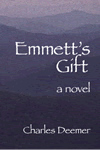
The Oregon Book Awards are the big literary prize in these parts. They are sponsored by Literary Arts, Inc., which does two things right: they use out-of-state judges and, more surprising because much more rare, they don't charge an entry fee. I've been a finalist three times, which qualified me for one of the joys of placing in the competition, which is to participate in the statewide reading tour. Having been very productive over the past couple years, this time around I have four books eligible: two in the novel category, Emmett's Gift and Love At Ground Zero, and two in the drama category, Five Screenplays and Three Oregon Plays.
How one does in a competition like this has more to do with the judges than with the writers. I say this both as a writer and one who has been a judge. The old cliche is true that there is no accounting for taste. The best work I've ever had eligible for the award, in my view, never even made the cut, which was a mystery and disappointment to me until I learned who the judge was: a woman whose work I don't think much of, so it made sense she would return the favor. I respond to crisp writing more than to overwriting, and when I've been a judge, my choices reflect this bias. All judges have biases.
How personal, even temperamental, all this can be is brilliantly illustrated in a book by Morris Weitz called Hamlet and the Philosophy of Criticism. Weitz looks at the body of criticism of Shakespeare's play through its long life, century by century, to reveal that in some ages the play was considered bad, in others quite good. There is no accounting for taste.
Writers typically make sense of this more readily when they lose a competition than when they win one. I know I have. That is, losing, one can find comfort in the fact that it's a crap shoot. But winning, what writer says, Well, I sure got lucky, rather than, It's about time because I really deserve this. Winners, more than losers, have to remember it's a crap shoot.
And a crap shoot it is. So wish me luck. Onward.
2/6/2004 10:33:33 PM |
Thursday, February 05, 2004
Good energy
In a high energy time, getting a ton of work done, including grunt work as I prepare two manuscripts for publication later in the year. Finished another chapter on the novel draft this morning. That is going well, too -- the real fun begins with the next rewrite, though, when I start focusing on rhetorical nuances (voice, etc.). Hopefully that will begin this summer. Since I always like to look ahead, been wondering what the next new project will be (perhaps as early as late summer but surely before the end of the year). Have a list of about half a dozen viable ideas to choose from. Probably depends on my mood at the time. Onward.
2/5/2004 12:57:45 PM |
Imagine this ...
From today's Today in Literature, a story I had not heard before:
"The French Revolution," by Thomas Carlyle, who died on this day
in 1881. Carlyle's classic is praised for being both scholarly
and one of the nineteenth century's "grand poems," but it is not
quite what he originally had in mind. The following entry from
his "Journal" describes the moment when he received the news that
his manuscript of Volume I, lent to John Stuart Mill and taken as
scrap paper by his maid, had been tossed in the fire:
"Last night at tea, Mill's tap was heard at the door: he entered
pale, unable to speak; gasped out to my wife to go down and speak
with Mrs. Taylor [later Mill's wife]; and came forward (led by my
hand, and astonished looks) the very picture of desperation.
After various inarticulate utterances to merely the same effect,
he informs me that my First Volume ... was except four or five
bits of leaves irrevocably ANNIHILATED! I remember and can still
remember less of it than of anything I ever wrote with such toil.
It is gone, the whole world and myself backed by it could not
bring that back; nay the old spirit too is fled.... Mill very
injudiciously stayed with us till late; and I had to make an
effort and speak, as if indifferent, about other common
matters...."
2/5/2004 06:59:42 AM |
Wednesday, February 04, 2004
Press release: Wayne Morse play
AMERICAN GADFLY: THE STORY OF WAYNE MORSE
A Play by Charles Deemer, Starring Claude Offenbacher,
Directed by Judith "Sparky" Roberts
Lane Community College Performance Hall
February 22, 2004 - Two Shows: 2:30 pm and 7:30 pm,
followed by a panel discussion moderated by
Caroline Forell of the Wayne Morse Center for Law and Politics,
University of Oregon Law School
Requested donation at the Door: $5-10
Proceeds from will go toward a Wayne Morse Free Speech scholarship.
Lane Community College students will be admitted free with an advance
ticket from the Student Government office, Building 1.
The first 75 University of Oregon students will be admitted Free at
each performance.
***
The Premier production of the one-man play, “American Gadfly: The Story
of Wayne Morse” will be presented, appropriately, in Morse’s home town
of Eugene. Eugene's Federal Building is soon to be named for Wayne
Morse , with a Free Speech Plaza and Morse statue.
After each 40-minute show, a panel of speakers, both pro and con, will
reflect upon the controversial Senator, his career and his ideas.
Support for this program comes from: Lane Community College, The Wayne
Morse Center at U of O, Concerned Faculty for Peace and Justice, and
The Wayne Morse Historical Park Society.
Morse strongly wished for people to be educated. He believed that an
educated citizenry was critical to the defense of liberty.
The producers hope to take the play to campuses and civic groups
state-wide. A contribution may be made through the Lane College
Foundation, toward furthering a tour, or towards a new Wayne Morse
scholarship.
The début performance will be dedicated to the memory of George
Alvergue, recently deceased, a Political Science teacher who also
served on the Board of Directors of both Lane Community College and the
Wayne Morse Historical Society.
Contacts:
Steve Candee (campus advisor)- Tel: 541-463-5188
Laura Olson (information) - Tel: 541-896-3298
Caroline Forell (project advisor) - Tel:
346-3699
Judith Roberts (director) - Tel: 541-686-9781
From Playwright Charles Deemer
What attracted me to Wayne Morse is that he did not enter politics as a
career politician. He was drafted to run for office by Oregon
Republicans when he was Dean of the Law School at the University of
Oregon, the youngest such dean in the country. Thereafter, Oregonians
continued to elect him for a long time, even after he left the
Republicans and became an Independent and later a Democrat.
Morse never compromised his background as a constitutional lawyer,
which made him an important voice in international affairs - more
articulate in behalf of principles of international law than any in
Congress since - a voice especially missed in days like these when so
many crises in foreign affairs challenge us. Morse also spoke strongly
for labor and for education, other areas in trouble today.
But what is missed most is his political courage - he was a man who
stood on principles before party loyalty. He was a rare political bird,
a true maverick. He was just as Socrates described it, a man sent by
the gods to keep the State honest. We desperately need that kind of
gadfly today. Without someone playing this role with clarity and skill,
the government gets away with too much (as now).
http://www.ibiblio.org/cdeemer
From Director Judith “Sparky” Roberts
We live in an age of cynicism about Government. Senator Wayne Morse was
not a cynic - he felt his calling was to serve his country with courage
and integrity. There are still many Oregonians around who can tell you
a lot about Wayne Morse! Even outside of Oregon, all over the country,
Morse was “Everyone’s Senator” - a third senator for independent-minded
people.
Morse wanted to shake up the status quo, even if it meant being
unpopular. "The Tiger of the Senate" could be brassy, and he was often
mocked for his righteous anger. Though some in Congress called him
"unstable," he was actually well-grounded. Morse's home was a small
Oregon farm. As a lawyer, he did labor arbitration, and then
campaigned as a man of the people. He was a wise realist, whose views
were based in his knowledge of Constitutional law.
In Charles Deemer’s play, Morse speaks about big issues that haven’t
gone away, such as: preserving the country’s natural resources;
protecting civil rights; educating everybody in the country;
controlling the power to make war; and finding paths to peace.
Morse’s honest rhetoric is still enlightening, thought-provoking, and
relevant.
These are scary times. Frankly, I just wish everybody had even a
smidgen of Morse’s courageous clarity and his prescient overview, which
he articulated with passion. He was a thoughtful and fair man. He urged
Congress to get off its high horse and start thinking about the next
generation.
2/4/2004 07:08:11 PM |
The Seagull Hyperdrama
I spent over ten years writing The Seagull Hyperdrama, about half of which was spent translating Chekhov (so I would own the English version). I put it online in the summer of 2002.
Now I've decided to come out with a print version despite the considerable grunt work necessary to adapt hypertext to a linear presentation. Why? To get it in the library. No telling what nut may find it there. (It's happened before, and to me).
A friend calls this my Masturbation Play. So be it. Let's not forget what Woody Allen had to say about that: masturbation is sex with your favorite person. Onward.
2/4/2004 10:59:42 AM |
|
|
| |
 __The Writing Life
|
|
|
